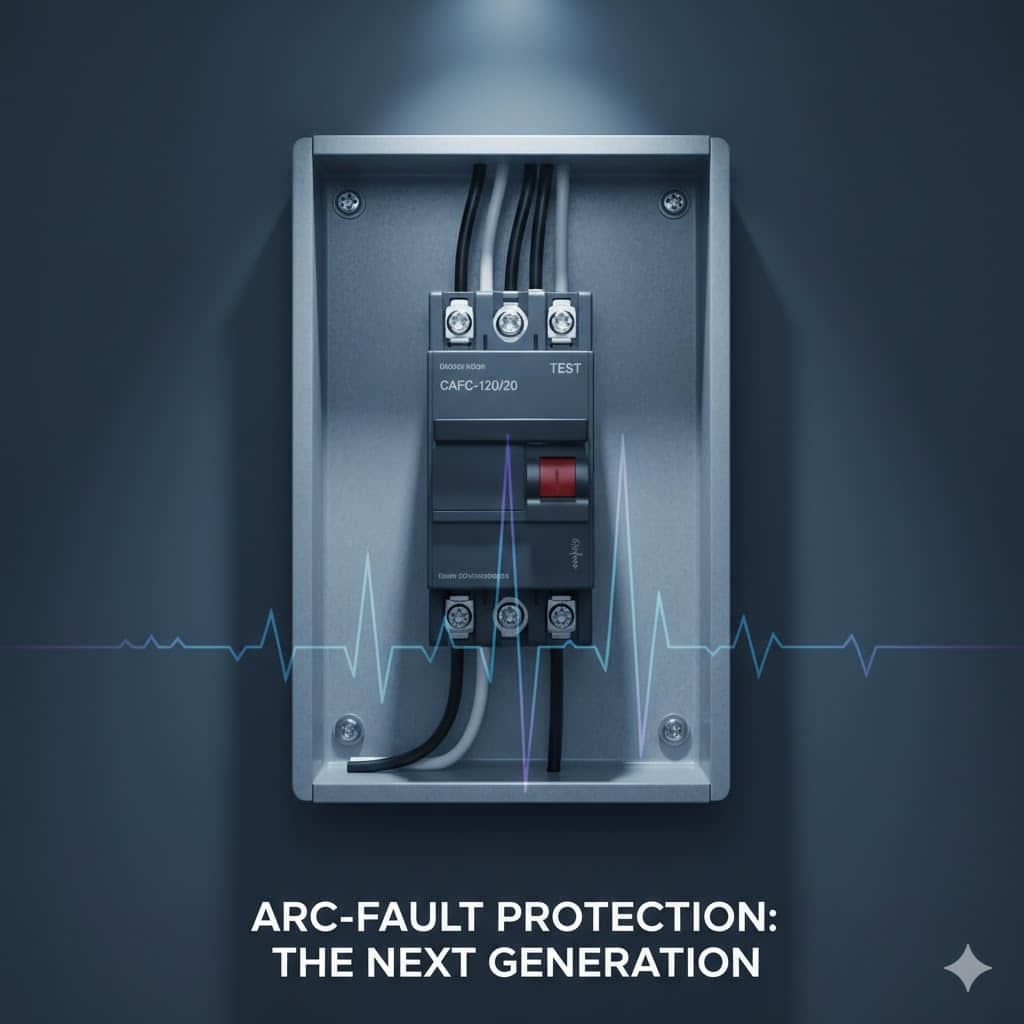
Elevating Home Electrical Safety
The foundational first step in installing an Arc-Fault Circuit Interrupter (AFCI) is the absolute shutdown of main power to ensure safety across the board. Once secured, the removal of the existing standard breaker allows you to begin the essential wiring process for the modern unit.
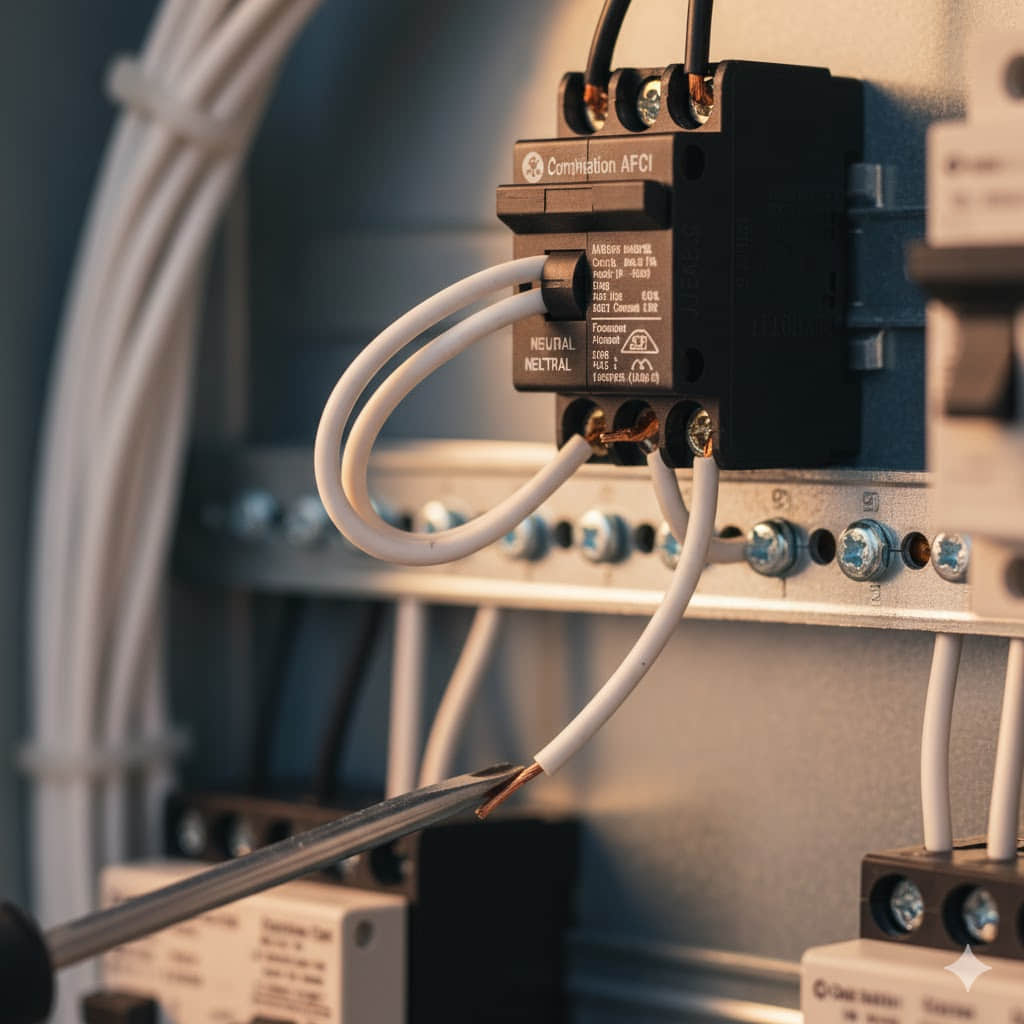
The new AFCI breaker requires its dedicated white neutral "pigtail" wire to be firmly attached to the panel's neutral bus bar. Simultaneously, the circuit's incoming neutral wire (white) and hot wire (black) must be meticulously connected to the breaker's silver 'N' terminal and brass 'L' terminal, respectively.
This process is then followed by re-energizing the system and validating its protective function with a mandatory press of the 'TEST' button.
Arc-Fault Circuit Interrupters (AFCIs) are an absolutely crucial component within any contemporary electrical safety framework. This sophisticated technology is engineered to detect and instantly interrupt hazardous electrical arc faults, which statistics show are a leading cause of residential structural fires.
Because this operation involves high safety requirements and is more complex than installing a standard thermal-magnetic breaker, the successful installation demands attention to system compatibility and precise wiring torque that goes far beyond basic steps. This rigorous attention ensures the device's long-term reliability and effectiveness.
This comprehensive guide moves beyond simple instructions; it is crafted from the perspective of a seasoned electrical engineer, offering a meticulous breakdown of every critical phase involved in AFCI installation. The goal is to guarantee that you not only know how to install it, but also truly understand why each step is performed and its safety implications.
Key Takeaways for the Professional Installation
Safety is Non-Negotiable: Before you place a hand inside the panel, you must turn off the main circuit breaker. Use a dedicated voltage tester to unequivocally confirm that all bus bars within the distribution panel are de-energized and possess a zero-voltage state.
Compatibility Check: The chosen AFCI breaker must possess perfect compatibility with the brand manufacturer and the voltage rating of your existing electrical panel. Failure to match brands voids safety certifications and poses extreme risks.
The Neutral Wire Conundrum is Critical: The white "pigtail" wire permanently attached to the AFCI breaker must be connected to the panel's neutral bus bar, which provides operating power to the breaker's internal electronics. Conversely, the circuit's own white neutral wire must be connected to the AFCI breaker's dedicated silver 'N' terminal. Mixing these two distinct white wires is the single most common installation error leading to immediate nuisance tripping.
Engineering Precision through Torque: Every terminal screw connection must be tightened using a calibrated torque screwdriver, torqued to the precise inch-pound specification mandated by the breaker's manufacturer. This value commonly falls within the specific range of 20 to 30 inch-pounds; this precision is vital for long-term safety.
Functional Verification is Mandatory: After the installation is fully complete and the power is restored, you absolutely must press the "TEST" button located on the face of the breaker. This action confirms that the unit successfully trips, thus validating that the sophisticated arc detection mechanism is fully operational and ready to protect the circuit.
PART I: Electrical Fundamentals and Compatibility Assessments
1.1 AFCI Core Technology and Type Differentiation
Before initiating any physical installation work, it is fundamentally important to grasp the underlying mechanism of AFCI operation and the specific types available in the market. An AFCI continuously monitors the circuit's current and voltage characteristics.
It utilizes highly complex and sensitive electronic algorithms to identify unique, high-frequency energy signatures characteristic of a dangerous electrical arc, distinguishing it from the normal current patterns produced by equipment like a motor starting. This is a level of protection far more advanced than that offered by a standard thermal-magnetic breaker, which only reacts to prolonged overcurrents or severe short circuits.
The Two Principal AFCI Types and Selection Guidance
The vast majority of residential and light commercial applications utilize one of two primary AFCI types. Choosing the correct one is determined by prevailing code requirements and the level of protection desired.
Branch/Feeder Type AFCI: This foundational type of breaker is installed at the beginning of the distribution panel and is primarily designed to protect the wiring from the breaker slot up to the first outlet or switch on the circuit. While they offer protection against parallel arcs (hot-to-neutral or hot-to-ground faults), they are significantly less effective at detecting the more common and dangerous series arc faults that occur within the run of a damaged cable.
Combination Type AFCI (CA-AFCI): This is the modern standard, representing the highest level of protection and is virtually the mandatory type for all new construction and remodeling projects as per the most recent National Electrical Code (NEC). CA-AFCIs incorporate superior sensing technology, giving them the unique ability to effectively detect both series arc faults (which happen when a single conductor is broken or loose, causing a dangerous gap) and parallel arc faults (which occur when current jumps between two conductors).
AFCI vs. GFCI: Distinctions and Coexistence
It is extremely common for novices and even experienced DIY enthusiasts to confuse AFCIs with GFCIs (Ground Fault Circuit Interrupters). From an electrical safety engineering standpoint, their respective protection objectives are fundamentally distinct, yet both are absolutely crucial for a modern home.
They target entirely different failure modes in the electrical system, and understanding the difference is a mark of true expertise.
| Feature | AFCI (Arc-Fault Circuit Interrupter) | GFCI (Ground Fault Circuit Interrupter) |
| Primary Safety Goal | Designed to prevent electrical fires caused by dangerous arcing. | Designed to prevent fatal electrical shock caused by current leakage through a person or an unintended path to the ground. |
| Detection Principle | Monitors the current waveform for high-frequency, random, and erratic electrical noise characteristics unique to arcing. | Monitors the current difference between the hot wire and the neutral wire (current imbalance). |
| NEC Mandatory Zones | Living areas, bedrooms, dens, libraries, and other habitable spaces where fire risk is higher. | Wet areas such as kitchen countertops, bathrooms, garages, outdoors, and unfinished basements. |
The Coexistence Requirement
In specific residential areas like laundry rooms, kitchens, and sometimes garages, the National Electrical Code (NEC) may, in fact, mandate the presence of both AFCI and GFCI protection simultaneously. When this occurs, the typical engineering solution is to install a specialized Dual-Function (AFCI/GFCI) Breaker, which integrates both protective mechanisms into a single unit at the panel.
Alternatively, an AFCI breaker can be used at the panel for arc protection, while a GFCI receptacle is installed at the load end for ground-fault protection. This setup requires meticulous attention to wiring to avoid conflicts.
Tip: The Combination Type AFCI (CA-AFCI) stands as the current industry benchmark because its detection capabilities are the most comprehensive, covering both series and parallel arc faults. When making your purchase, always ensure the product packaging explicitly states "Combination Type" or "CAFI" to guarantee the highest safety standard.
1.2 Pre-Installation Panel Compatibility Verification
Before any purchase is finalized and certainly before the installation begins, performing a rigorous compatibility check is the quintessential professional step in project planning. Installing an incompatible breaker is not just an inconvenience; it poses a catastrophic safety hazard that can potentially damage your entire distribution panel or lead to fire.
1. Brand and Model Matching (Manufacturer Specificity)
The Cardinal Rule: The breaker you select must be an exact match for the manufacturer and the specific product line of your existing electrical panel. For instance, a Square D HomeLine panel absolutely demands a Square D HomeLine AFCI breaker; a mismatch is a non-starter.
This strict requirement exists because each manufacturer uses proprietary designs for their bus bar interface, the clip mechanism, and the physical electrical connection. A mismatched breaker cannot establish a safe, reliable, and UL-certified connection.
2. Bus Bar Type and Voltage Rating
You must verify that the AFCI breaker's voltage rating (typically 120V single-pole for residential lighting/outlets, or 240V double-pole for large appliances) perfectly aligns with the required circuit load. Furthermore, closely inspect the panel's bus bar design.
While most modern residential panels utilize a plug-in design, some older or industrial panels may use a bolt-on connection, requiring a completely different type of breaker.
3. Space and Gutter Space Assessment
Physical Volume Consideration: Due to the integrated electronics, sophisticated sensing circuitry, and the mandatory test mechanism, AFCI breakers (especially combination or dual-function models) are inevitably physically larger than their standard thermal-magnetic counterparts. You must visually confirm that there is sufficient lateral space within the panel to accommodate the increased width of the new AFCI breaker.
Wiring Space (Gutter Space): The AFCI installation requires an extraordinary amount of wire management: its own pigtail neutral wire, plus the circuit's neutral and hot wires, must all be routed within the panel. This necessitates confirming adequate Gutter Space (the area between the panel's sides and the surrounding metal housing) to prevent the excessive bending or pinching of conductors, which can damage insulation over time.
4. Neutral Bus Bar Connection Capacity Check
The Pigtail Requirement: Since every AFCI breaker requires its own dedicated white pigtail wire to be connected to the main neutral bus bar, you need to check the bus bar to ensure there are enough vacant screw terminals available to securely accommodate every new AFCI you plan to install. If you find the neutral bus bar is already full, you will be required to legally install an approved neutral bus bar extension kit to gain additional termination points before proceeding with the installation.
Note: Absolute panel brand matching is a rigid, zero-tolerance requirement. Utilizing a breaker from a different manufacturer is extraordinarily dangerous, instantly voids the UL listing for your panel, and will render your homeowner's insurance and product warranty invalid in the event of a failure. Always cross-reference the model label found on the inside of your panel door before purchasing any replacement breaker.
PART II: Safety Protocols, Tool Verification, and Removal Procedures
2.1 Preparation and Uncompromising Safety Protocol
Electrical work must adhere to the highest possible safety standards, and no step should ever be rushed or performed at the expense of safety. This is not a domain for guesswork; it is a discipline that demands rigorous adherence to protocol.
1. ⚡️ Mandatory Main Power Disconnection
You must locate the main disconnect or main breaker situated either within the distribution panel or immediately adjacent to it, and unequivocally switch it to the "OFF" position. This action physically severs the incoming electrical supply from the utility grid, de-energizing the main bus bars.
Following this, before you remove the exterior panel cover, it is essential to place a highly visible, robust warning tag (such as a "DANGER: DO NOT OPERATE/WORKING ON CIRCUIT" tag) over the main breaker and all branch breakers to prevent accidental re-energization by others.
2. Double-Verification of Zero Energy State (Zero Energy Verification)
Carefully and methodically remove the panel cover screws and lift the cover away, placing it in a safe location where it cannot be damaged or accidentally stepped on. Using a reliable non-contact voltage tester (NCVT), check every single visible hot bus bar and every exposed wire terminal for any sign of voltage, using this as your initial confirmation.
The Professional's Second Step: The NCVT is merely an indicator; true safety demands a more reliable instrument. You must use a calibrated digital multimeter (DMM) or a robust contact-style voltage tester to physically measure the voltage directly between the hot bus bars and the neutral bus bar, as well as between the hot bus bars and the grounding bus bar. You must ensure that the reading is an unambiguous 0V (Zero Volts), as this contact-style measurement is the only reliable method for absolutely verifying a zero energy state before proceeding further into the enclosure.
3. Personal Protective Equipment (PPE) Compliance
Always wear fully rated, insulated safety glasses or goggles throughout the entire process to protect your eyes from debris, accidental sparks, or any unexpected flash. Ensure you are standing on a dry, rubber-soled pair of boots or shoes, which acts as a secondary, crucial layer of insulation between your body and the ground plane.
Tool Isolation: You must only use tools that feature fully rated, insulated handles, such as a set of certified insulated screwdrivers. This simple precaution prevents your hand from inadvertently becoming a conductor should you accidentally touch a live component within the enclosure.
2.3 Methodical Removal of the Existing Breaker
The removal of the old circuit breaker must be a systematic and controlled process designed to prevent any accidental contact or short circuits from occurring inside the highly sensitive panel.
1. Positive Circuit Identification
Before touching anything, re-verify the specific circuit you are targeting for replacement and the corresponding breaker slot by consulting your panel's legend or label. Trace the wires associated with that circuit back to the cable entrance point to confirm the pairing of the hot and neutral wires that belong together.
2. Strict Wire Disconnection Sequence
Disconnect the Hot Wire First: Using the insulated screwdriver, carefully loosen the terminal screw securing the black (or red) hot wire to the old breaker's brass terminal. Then, gently but deliberately remove the wire, ensuring that its exposed copper end does not touch any bare metal surface inside the panel.
Disconnect the Neutral Wire. Second: If your old unit was a standard breaker, its white neutral wire was almost certainly connected directly to the panel's neutral bus bar. Loosen the terminal screw and gently remove this white neutral wire from the bus bar, again ensuring isolation.
The Ground Wire is Last: The ground wire (typically bare copper or green) is usually left connected to the panel's dedicated grounding bus bar. If any adjustment is necessary to make space for the new AFCI, it should only be handled after the hot and neutral conductors are fully secured and isolated.
3. Removing and Inspecting the Old Breaker
Tilt the old breaker slightly outward and firmly pull it away from the bus bar connection clip and out of its slot. Discard the old breaker immediately, as it cannot be reused in an AFCI-protected circuit configuration.
Conductor Condition Check: Before installing the new AFCI, perform a meticulous inspection of the ends of the wires that were just removed. If the conductors show any signs of frayed strands, damage to the insulation sheath, or severe flattening of the wire end caused by excessive pressure from the old terminal screw, you must use a sharp pair of wire strippers to cut away the damaged end and re-strip a fresh, clean section of conductor, which is essential for guaranteeing a robust, low-resistance electrical connection with the new AFCI unit.
Tip: When performing any work inside the electrical panel, always stand on a dry, non-conductive insulating surface. Make a conscious effort to only use one hand for the actual work inside the panel, keeping your other hand physically away from any metal surface of the enclosure; this dramatically reduces the potential path for current to pass through your body in the event of an accidental contact with a live component.
Professional Reference: Visualizing the AFCI Breaker Installation Process
To provide you with the most tangible and authoritative reference for the process of old breaker removal, the specialized wiring configuration of the AFCI, and the final functional test, we strongly recommend reviewing the professional instructional video, "How to Install an AFCI Breaker," published by The Home Depot.
The key segments of this video (specifically the [00:01:27] to portions) serve as an excellent visual aid that flawlessly demonstrates the following critical steps:
The Exact Disconnection Sequence: It shows the correct professional practice of disconnecting the hot wire first, followed by the neutral wire from the neutral bus bar.
The AFCI's Essential Three-Wire Connection: It explicitly illustrates routing the AFCI's permanently attached white pigtail wire to the main neutral bus bar. Concurrently, the circuit's original white neutral wire is directed into the AFCI breaker's 'N' terminal on the body of the unit.
Mandatory Functional Verification: The final step clearly shows the required action of pressing the 'TEST' button to confirm the protective function is active.
PART III: Critical AFCI Wiring and Torque Control
3.1 The AFCI’s Unique Wiring Mandate
The internal technology of an AFCI breaker is designed to continuously monitor and compare the current flowing out on the hot wire and the current returning on the neutral wire of the entire circuit. To execute this sophisticated comparison and arc-sensing function, the circuit's neutral wire is required to pass through the AFCI breaker body first.
This is a key difference, as it is not simply connected directly back to the panel's neutral bus bar, as is the case with standard breakers.
| Wire Origin/Type | Connection Destination | Terminal Color/ID | Internal Function Analysis | Engineering Criticality |
| AFCI Self-Contained Neutral (Pigtail Wire) | Panel Neutral Bus Bar | White (Often coiled) | Provides a continuous 120V reference and operating power source for the AFCI's internal electronic monitoring circuitry. | Absolutely Required to be Connected; the breaker will not function without this dedicated power source. |
| Branch Circuit White Neutral | AFCI Breaker Silver/'N' Terminal | Passes the circuit's return current through the internal sensor coil for current balancing and arc signal detection. | Must NOT be connected to the panel neutral bus bar; doing so bypasses the sensor and will inevitably cause immediate nuisance tripping. | |
| Branch Circuit Black Hot Wire | AFCI Breaker Brass/'L' Terminal | The main power conductor for the circuit load. | Connects the incoming power from the panel bus bar to the circuit wires feeding the receptacles and lights. | Standard Connection Point. |
| Branch Circuit Ground Wire (Bare Copper/Green) | Panel Grounding Bus Bar | Provides protective grounding only. | Must remain connected to the panel's dedicated grounding system and must NOT be routed to the AFCI breaker unit. |
The Specific Step-by-Step Wiring Procedure
Connect the AFCI Pigtail: Take the AFCI breaker's self-contained white coiled wire (the pigtail) and securely terminate it onto a vacant screw terminal on the panel's main neutral bus bar.
Seat the Breaker Body: Insert the main body of the AFCI breaker firmly onto the designated bus bar clip, ensuring it is fully seated and securely locked into place. The breaker handle must remain in the "OFF" position.
Connect the Circuit Neutral Wire: Take the white neutral wire originating from the branch circuit and meticulously terminate it into the silver/'N' terminal located directly on the AFCI breaker body.
Connect the Circuit Hot Wire: Take the black hot wire originating from the branch circuit and securely terminate it into the brass/'L' terminal located on the AFCI breaker body.
Note: This is the most significant and recurring installation pitfall for all non-professional installers. The principle is non-negotiable: the circuit's white wire (the load neutral) must now connect to the breaker terminal, and not directly to the main neutral bus bar. If you get this wrong, the breaker will instantaneously trip the moment you restore power.
3.2 The Critical Engineering Imperative: Terminal Torque
In the world of electrical connections, the precise application of Terminal Torque is the single most important parameter determining the connection's long-term quality, reliability, and ultimately, its safety. This step is routinely ignored by casual installers but is a strictly enforced, non-negotiable requirement for every professional electrical engineer and licensed electrician.
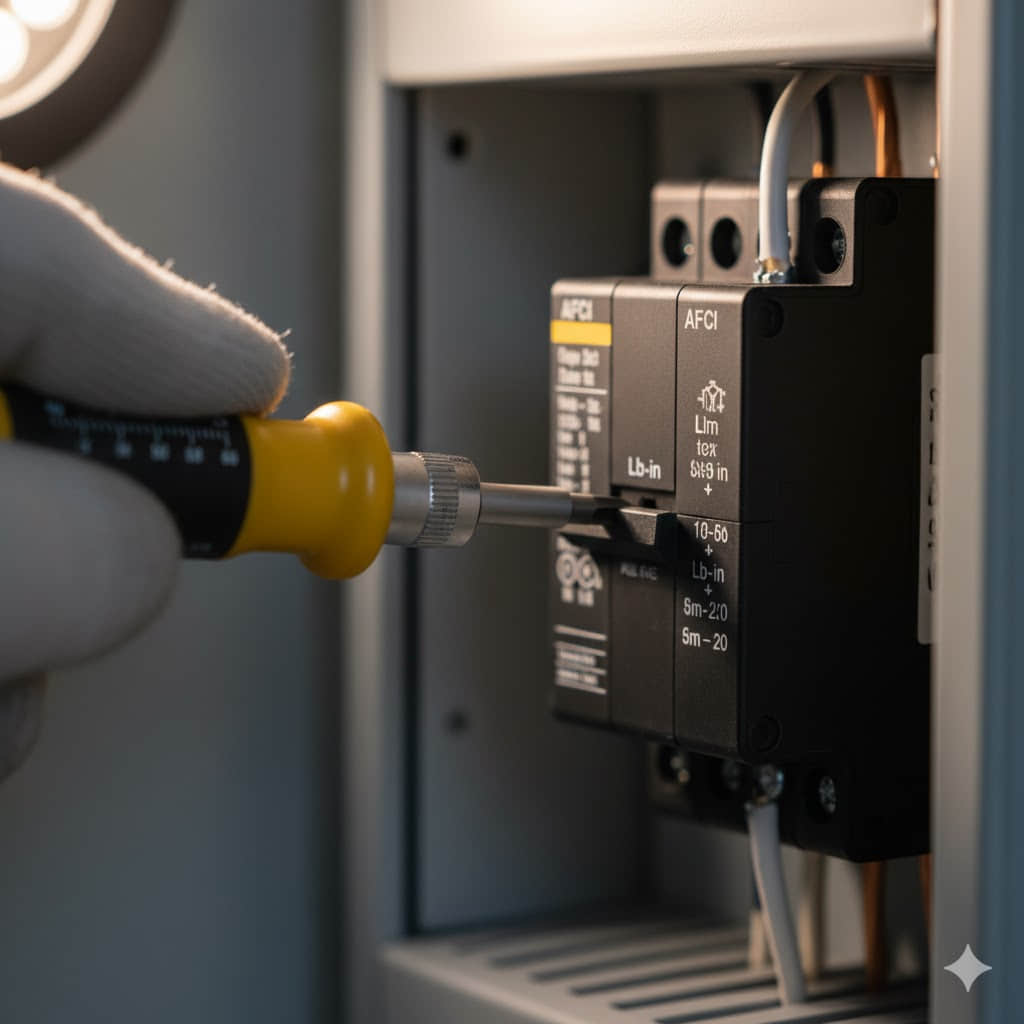
The Code Requirement: Pursuant to the National Electrical Code (NEC) Section 110.14(D), all terminal screws and wire connectors must be tightened to the exact inch-pound value specified in the equipment manufacturer's instructions. This means simply making it "hand-tight" or "snug" is a clear violation of code and a serious safety risk.
Manufacturer Specifications: For the majority of residential circuit breakers, the specific terminal screw torque requirement typically falls within the range of 20 inch-pounds to 30 inch-pounds. However, it is your responsibility to meticulously consult the label printed on the side of your specific breaker for the precise value.
Risk Analysis of Incorrect Torque
Low Torque (Under-Tightened): If the terminal screw is not tightened sufficiently, the inadequate pressure between the wire conductor and the terminal surface will result in high contact resistance. When current flows through this high resistance point, it generates excessive heat, following the physical principle of Ohm's Law, P = I^2R.
This heat generation accelerates the degradation of the wire's insulation, causes the metal conductors to expand and contract, leading to a loose connection, and will ultimately result in a dangerous electrical arc fault or fire.
High Torque (Over-Tightened): Applying too much force risks overtightening the screw, which can physically crush or damage the individual strands of the copper or aluminum conductor, reducing its effective cross-sectional area and diminishing its current-carrying capacity. Excessive torque can also permanently damage the internal threads of the breaker terminal or fracture the plastic housing, requiring the entire unit to be replaced.
The Professional Tool: It is highly recommended that you acquire and use a calibrated torque screwdriver specifically designed for electrical work to execute all terminal connections. This is the only way to ensure that every conductor is secured with the exact, specified mechanical force, guaranteeing both a low-resistance electrical pathway and the long-term reliability and safety of the connection.
Tip: When securing the terminal screw, first seat the wire fully into the terminal slot, then tighten the screw to the mandated specification, aiming for approximately 25 inch-pounds if a specific value is unavailable on the label (though a specific value should always be sought). Never attempt to use raw wrist strength or guesswork to "feel" the tightness, as this is a recipe for long-term safety hazards.
3.3 Final Installation and Panel Restoration
Wire Management: Take time to meticulously route and dress all conductors, paying particular attention to the AFCI pigtail, the circuit neutral, and the hot wire. Ensure the wires are neatly organized and that no lines are crossing or pressing against the sharp edges of the panel or other internal components, which could compromise insulation integrity.
Panel Cover Re-Installation: Carefully and slowly reposition the main panel cover, ensuring that no wires are pinched or put under undue stress before aligning the screw holes. Finally, securely tighten all the retaining screws to fasten the panel cover in place.
PART IV: Testing, Advanced Diagnostics, and Long-Term Maintenance
4.1 Re-Energization and Standardized Testing Protocol
The critical final step in any professional electrical installation is the functional verification, which serves to confirm that the AFCI's sophisticated electronic protection mechanism is fully operational and standing guard. This sequential process is designed to prevent sudden equipment overload.
1. Sequential Power Restoration (The Cold Start)
Begin by ensuring the handle of the newly installed AFCI breaker remains firmly in the "OFF" position. Next, go to the panel's main disconnect and switch the Main Breaker back to the "ON" position, which restores power to the overall bus bars within the panel enclosure.
Finally, sequentially switch the AFCI breaker handle to the "ON" position, which re-energizes the specific branch circuit under its protection.
2. The Mandatory Standard Test
Locate and press the conspicuous "TEST" button located directly on the face of the AFCI breaker. This action initiates an internal test sequence that simulates a controlled electrical arc fault signal within the unit's circuitry.
Expected Outcome and Troubleshooting: The breaker should immediately trip (open the circuit), moving its handle to a middle or fully "OFF" position. If the test is successful, you must reset the breaker by firmly pushing the handle fully toward "OFF" and then back to "ON" to restore circuit power. If the breaker fails to trip, it indicates a critical installation error (such as an improperly connected or missing pigtail neutral wire) or a potentially defective breaker unit, requiring immediate power shutdown and thorough diagnosis or replacement.
4.2 Advanced Fault Diagnosis: Resolving Nuisance Tripping
Nuisance tripping, often called "false tripping," is the most frequent complaint from AFCI users, occurring when the breaker unnecessarily trips the circuit when no true hazardous arc fault is actually present. A professional diagnostic approach is essential here, providing the user with a methodical framework that separates an engineer's systematic troubleshooting from a common trial-and-error approach.
Phenomenological Analysis
Many older appliances, especially power tools containing worn carbon-brush motors (like old vacuum cleaners or power drills), faulty switches, or certain types of low-quality or damaged switching power supplies, can generate bursts of high-frequency electrical noise during start-up or operation. This noise possesses wave characteristics that can be mistakenly identified by the highly sensitive AFCI electronics as the signature of a dangerous arc fault, leading to the frustrating false trip.
The EE Diagnostic Approach: Load Isolation
1. De-Energize and Disconnect All Loads: First, turn the AFCI breaker OFF and proceed to unplug or physically disconnect every single appliance, lamp, and electronic device from all outlets and switches on the tripping circuit.
2. Verify the Circuit Integrity: Reset the AFCI breaker to the "ON" position. If the breaker remains reset (does not trip) when there is no load connected, then the problem is unequivocally with the load (the appliance or device) and not the circuit wiring itself.
3. Sequential Re-Connection: Systematically plug or switch on devices one by one. The instant a specific device causes the AFCI to trip, that device is identified as the fault source. The user must then consider either replacing the problematic appliance or moving it to a non-AFCI-protected circuit, provided local code permits this action.
Wiring Integrity Check
If the AFCI continues to trip even after all loads have been disconnected, the problem is definitely within the circuit wiring or the panel connections. The most common wiring fault that causes this condition is an accidental or improper connection of the circuit's white neutral wire to the grounding wire (bare copper) or an unintended connection back to the panel's neutral bus bar at any point in the circuit (a condition known as a "multiple neutral connection" or a "shared neutral").
This fault destroys the AFCI's essential current balance monitoring mechanism. Should this occur, you must immediately contact a licensed electrician to perform a comprehensive physical inspection of all junction boxes, outlets, and switch boxes on the circuit.
Tip: When troubleshooting nuisance tripping, follow this professional, sequential path: First, definitively rule out the load problem (disconnecting all appliances). Second, rule out the wiring problem (checking for improper neutral/ground connections). This systematic approach represents the fastest and most reliable diagnostic procedure.
4.3 Maintenance and Advanced Checks
An AFCI is a complex electronic device, not a simple electromechanical component, and its electronics require regular testing to maintain integrity. Users are strongly advised to press the "TEST" button at least once every year to ensure that the internal mechanisms are capable of immediate and proper functional operation.
Advanced Diagnostic Memory: A significant feature in many modern AFCI units is their Diagnostic Memory capability. When a trip occurs, the breaker logs a specific internal code detailing the reason for the fault (e.g., thermal overload, short circuit, or a specific type of arc fault). A professional electrician, utilizing a specialized handheld reading device (like certain proprietary Circuit Breaker Analyzers), can access and read these codes. This data is invaluable for accurately determining if the trip was a genuine hazardous fault or merely a persistent nuisance trip, dramatically enhancing the efficiency of the troubleshooting process.
Conclusion
The proper installation of an AFCI breaker is a highly technical task that meticulously blends high-precision mechanical operations with rigorous regulatory compliance. The effective deployment of this critical safety device is achieved by strictly adhering to foundational safety procedures, paying meticulous attention to the complex and unique requirements of the AFCI's neutral wire connections, and using a calibrated torque tool to ensure every wire termination is reliable, low-resistance, and secure.
This guide, delivered from the perspective of an electrical engineer, has emphasized the crucial details of correct AFCI type selection, panel compatibility checks, the engineering necessity of precise torque control, and advanced diagnostic techniques. It is only by integrating these engineering-level requirements into the installation process that a residential electrical system can achieve the highest standard of fire protection and long-term stability.
Please remember this final commitment to safety: If you harbor any uncertainty regarding any operational step, or if you encounter persistent nuisance tripping that you cannot resolve using the diagnostic steps provided, for the sake of your safety and the integrity of your home, immediately consult a licensed and certified professional electrician.
Highly Relevant and Authoritative FAQ
Question: Is it permissible for me to install both an AFCI and a GFCI on the exact same circuit in series?
Answer: Yes, this setup is both common and often explicitly required by modern electrical codes, particularly in high-risk areas like laundry rooms and kitchens. However, you do not need to physically string them together in a series.
The most straightforward professional solution is to install a Dual-Function (AFCI/GFCI) breaker, which elegantly integrates both protective technologies into a single unit at the panel. The alternative approach involves using an AFCI breaker at the panel to protect the entire branch, then installing a GFCI receptacle as the first outlet on that line, thereby extending the ground fault protection downstream.
Question: I have completed all the wiring, but the AFCI trips instantly the moment I flip the main power back on. What is the most likely cause?
Answer: An immediate and persistent trip is almost invariably indicative of a fundamental wiring error within the panel itself, specifically related to the neutral connections. The overwhelmingly most common mistake is that the circuit's original neutral wire (white) has been mistakenly connected back onto the panel's main neutral bus bar, instead of being correctly terminated to the AFCI breaker's dedicated silver/'N' terminal.
You must immediately de-energize the entire panel and check two connections: Is the AFCI's self-contained white pigtail connected to the neutral bus bar? And is the circuit's white neutral wire connected to the breaker body's 'N' terminal? If these connections are reversed or incorrectly routed, the AFCI will always trip instantly.
Question: I purchased an AFCI breaker that is a different brand from my existing, older electrical panel. Can I still use it for my home?
Answer: Absolutely not, under any circumstances. This constitutes a grave safety hazard and is strictly prohibited by every major electrical code and safety organization globally. You are legally required to use a breaker that precisely matches the manufacturer and the product series of your electrical panel (for example, a Siemens panel must use a Siemens breaker).
Using a mismatched breaker prevents the formation of a safe, guaranteed connection to the bus bar, often leading to poor contact, overheating, and fire risk. This immediately invalidates your home's UL listing and potentially your insurance coverage.
Question: Why is the use of a precise screw torque so heavily emphasized? Is "tightening it by hand" truly inadequate?
Answer: Yes, tightening by hand is fundamentally inadequate and dangerous. Emphasizing precise screw torque is a cornerstone of professional electrical engineering. Relying on an estimated "hand-tight" feeling is unreliable and cannot guarantee a safe connection.
Insufficient torque results in a loose connection and high contact resistance. This high resistance generates dangerous heat, a known precursor to many electrical fires. Only a properly calibrated torque screwdriver ensures that the conductor is secured with the exact pressure specified by the manufacturer, guaranteeing long-term safety, sustained reliability, and preventing insulation damage from heat buildup.
Question: If my old vacuum cleaner consistently causes the AFCI to trip, does this mean there is a serious underlying problem with my circuit wiring?
Answer: Not necessarily. This scenario is most commonly referred to as "Nuisance Tripping," and the issue typically lies within the appliance itself. Many older appliances, tools with aging universal motors, or inexpensive power supplies generate a significant amount of high-frequency electrical noise when they operate or start up.
This noise's waveform closely mimics the signature of an actual arc fault, causing the highly sensitive AFCI to mistakenly trip. The common remedy is to move the problematic appliance to a circuit that is not AFCI protected (if local code allows), or, ideally, to replace the unit with a newer model that complies with modern electromagnetic compatibility standards. Your wiring is often perfectly safe under these circumstances, even if the old appliance is causing the breaker trouble.