I. Introduction: The Heart of the Grid
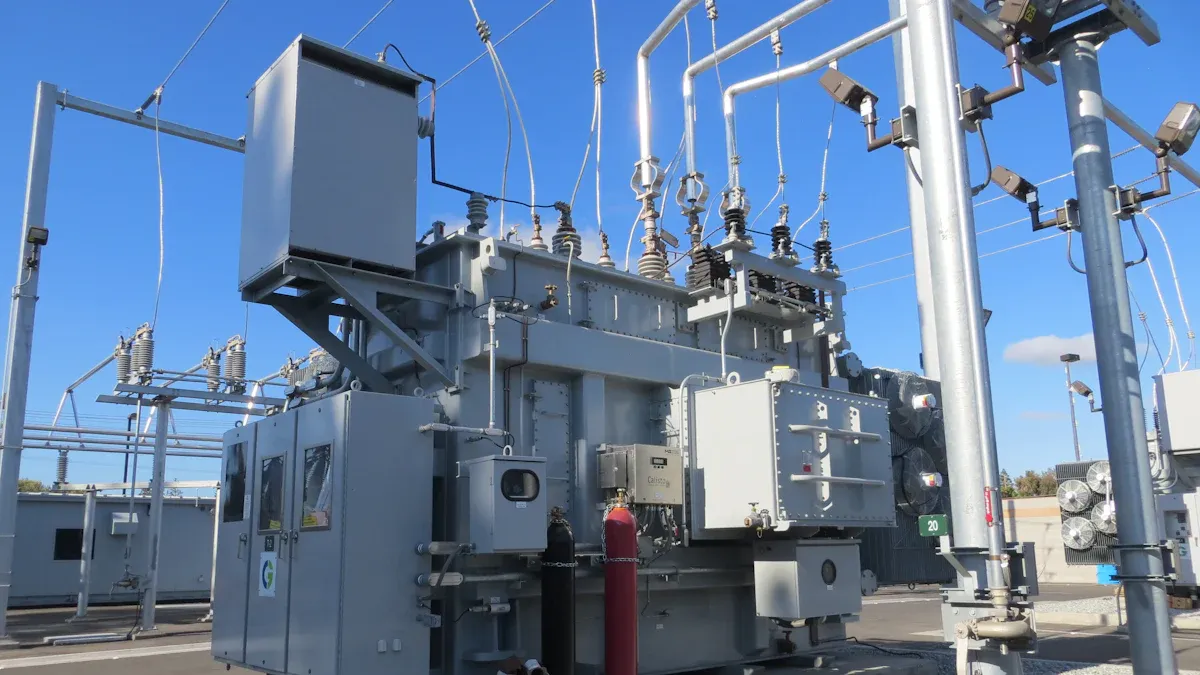
Step-up and step-down transformers are indispensable electromagnetic devices, fundamentally engineered to modulate Alternating Current (AC) voltage levels. The former boosts the voltage sky-high, while the latter skillfully dials it back down. These workhorses are non-negotiable fixtures in any modern electrical grid, relying on electromagnetic induction to transfer power efficiently.
They ensure that electrical energy can be hauled over vast distances from the generating station to every single consumer with minimal energy bleed and maximum reliability. In essence, these transformers masterfully resolve the core engineering conflict between maximizing efficiency through high-voltage transmission and guaranteeing operational safety through low-voltage usage.
— Key Takeaways for the Reader —
∙ Core Function: Transformers utilize electromagnetic induction to change AC voltage; step-up units increase it, and step-down units decrease it.
∙ Structural Difference: The ratio of wire turns, known as the turns ratio, is the defining physical factor, with step-up units requiring and step-down units .
∙ Energy Conservation: An ideal transformer does not alter power (), meaning voltage and current are inversely proportional.
∙ Critical Applications: Step-up transformers are essential at power plant exits for long-haul transmission, whereas step-down units are deployed for local distribution and feeding end-user equipment.
∙ Engineering Perspective: Real-world transformers suffer from copper and iron losses, making efficiency optimization a central pillar of sound electrical design.
II. The Fundamental Operating Principle of the Transformer
A transformer is a static piece of electrical gear, relying on Faraday's Law of Electromagnetic Induction to get the job done. It transfers electrical energy between two or more coils using a dynamic magnetic field, all without requiring any direct conductive contact between the coils (except in the case of an autotransformer).
1. Definition and Core Mechanism
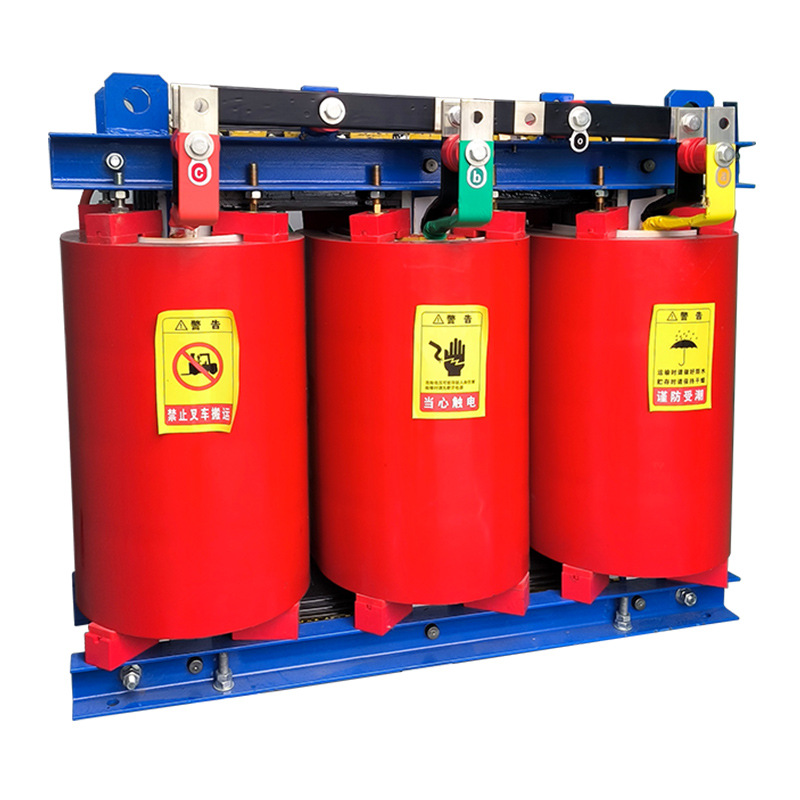
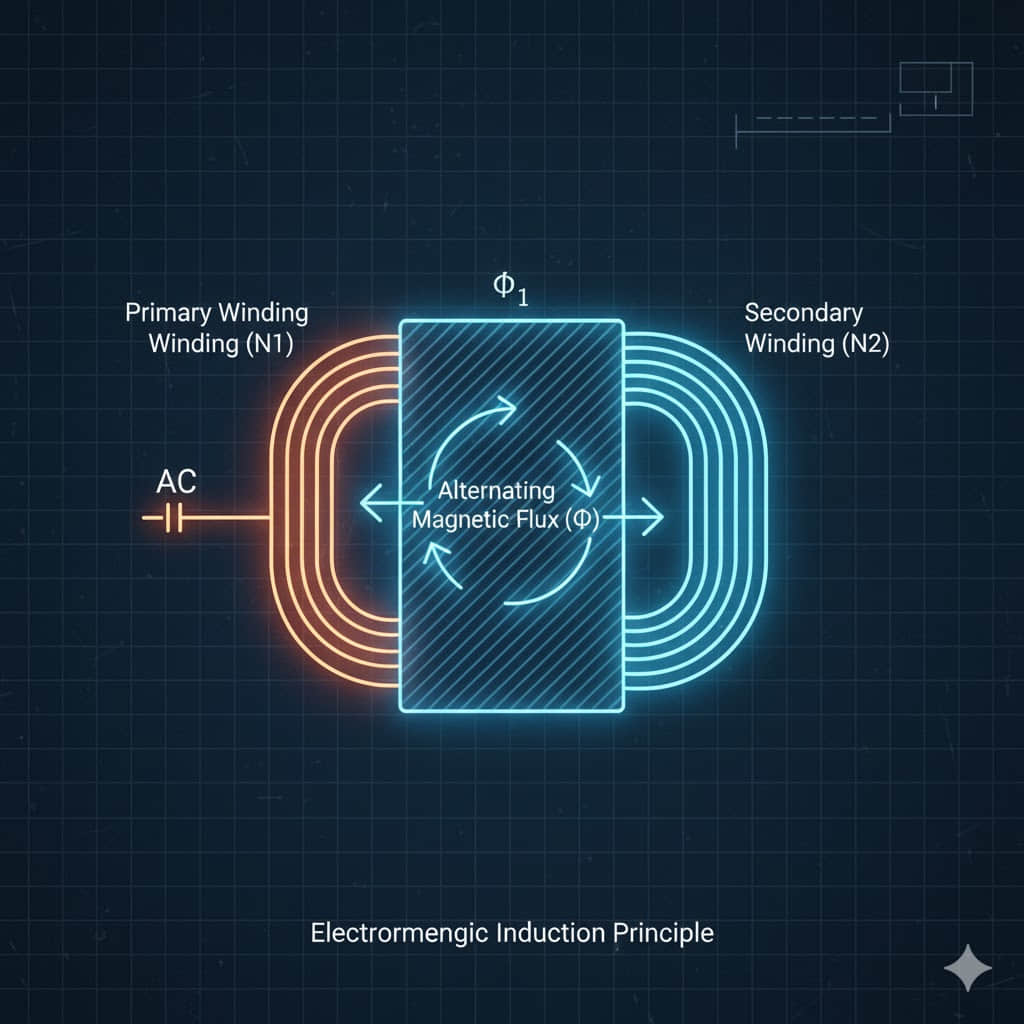
A typical transformer consists of three main components: the Primary Winding (N1), the Secondary Winding (N2), and the magnetic Core. When an AC voltage V1 is applied across the primary coil, it generates an alternating magnetic flux Φ(t) within the core, according to Lenz's and Faraday's laws. This fluctuating magnetic flux then cuts across the secondary coil, in turn inducing an alternating electromotive force, or voltage, V2.
It is crucial to remember that a transformer can only operate effectively in an Alternating Current circuit, since the generation of induced electromotive force requires the magnetic flux to be continuously changing.
2. Key Components Under the Hood
The primary winding, N1, is the coil connected to the source, dictating the input voltage to the system. The secondary winding, N2, is linked to the load side, delivering the transformed output voltage.
The magnetic core, often constructed from stacked, high-permeability silicon steel laminations, is instrumental in confining and guiding the magnetic flux. This crucial design feature minimizes magnetic leakage and dramatically boosts the efficiency of energy transfer.
3. The Core Transformer Equation: The Physics of Voltage Change (EEAT Insight)
From an engineering standpoint, the operation of a transformer is precisely governed and controlled by the ratio of turns in its windings. Assuming an ideal transformer model—which conveniently disregards losses and leakage flux—the mathematical relationships between voltage, turns, and current are rigorously defined as follows:
In this classic equation, V1 and V2 represent the primary and secondary voltages, respectively. N1 and N2 are the corresponding number of turns, and I1 and I2 denote the primary and secondary currents. The turns ratio, mathematically defined as , remains the central parameter for determining both the type and performance characteristics of any given transformer.
4. A Constant Frequency: A Defining AC Trait
A critical point to grasp is that the transformer, as an electromagnetic induction device, is fundamentally designed not to alter the frequency of the power source. This means that, regardless of whether the voltage is increased or decreased, the output frequency f2 must invariably equal the input frequency f1.
This constant frequency principle underscores that the transformer is solely responsible for the equivalent transfer of power, performing no frequency conversion or waveform correction, which distinctly separates it from modern power electronics converters like DC-to-DC or AC-to-DC devices.
This linked video provides a clear, intuitive demonstration of electromagnetic induction, contrasting the structural differences between step-up and step-down designs, and visually explaining the core transformer equation. It is an outstanding resource for cementing the foundational understanding of the physics discussed earlier.
III. The Step-Up Transformer: Going High Voltage
1. Function and Definition
The core mission of the Step-Up Transformer is perfectly captured by its name: it is designed to take a lower input AC voltage (V1) on the primary side and convert it into a much higher output AC voltage (V2) on the secondary side. This voltage boost is the essential first step in long-distance power distribution.
2. Structural Characteristics and Turns Ratio
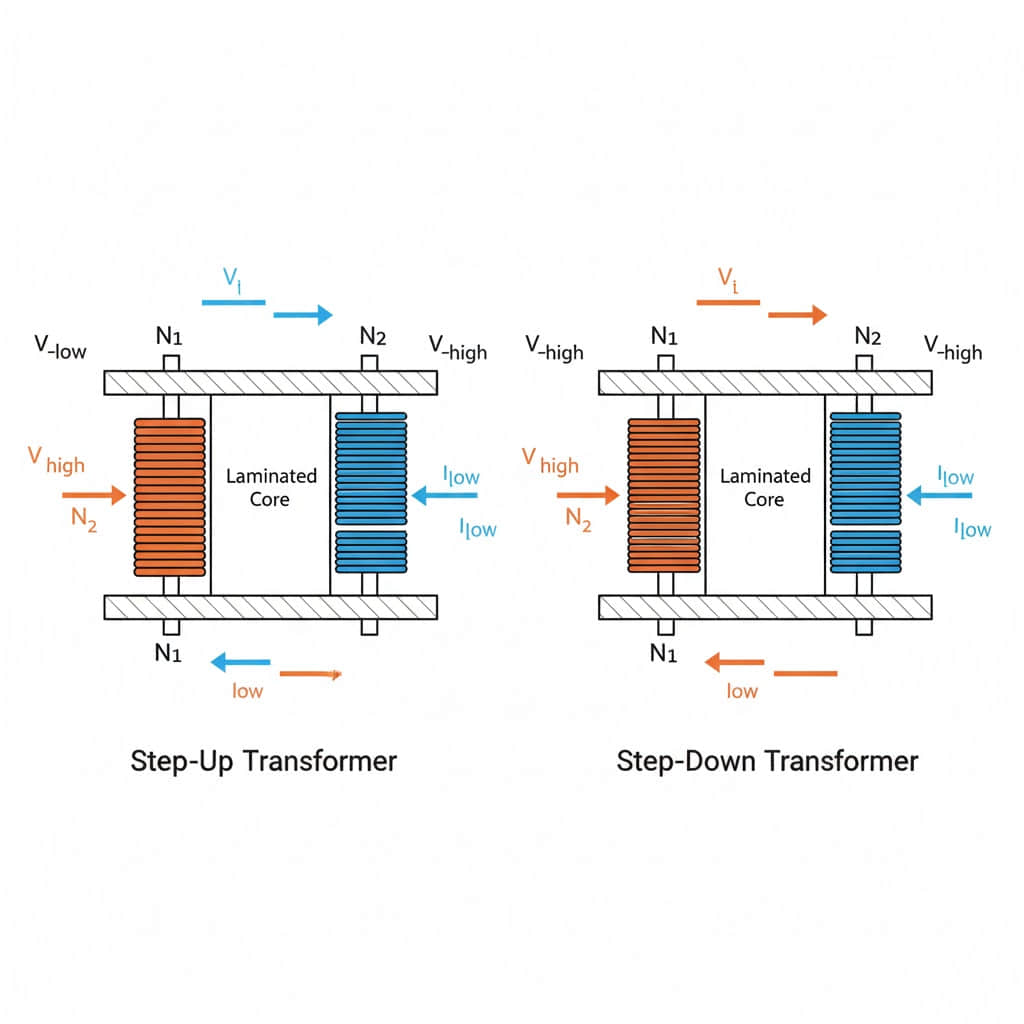
The definitive structural feature of a step-up transformer is that the number of turns on the secondary coil (N2) must be greater than the number of turns on the primary coil (N1). This results in a turns ratio greater than one.
The high-voltage side (secondary) uses more turns but typically employs thinner wire, which is a design trade-off that conserves material and space while accommodating the higher voltage stress.
3. The Voltage-Current Relationship: The I2R Efficiency Secret
Based on the ideal transformer equations and the principle of power conservation (), the step-up operation—while boosting voltage—necessarily results in a proportional reduction in current. This relationship is non-negotiable and dictated by physics.
This critical reduction in current is the entire physical and economic justification for long-distance power transmission. Power loss (Ploss) during transmission is primarily dictated by resistive loss, or copper loss, governed by the formula . By using a step-up transformer to elevate the voltage from Vlow to Vhigh, the current I is reduced proportionally, while the loss Ploss dramatically drops by the square of the current reduction factor.
∙ Tip for Linemen and Engineers: The fundamental economic driver behind utility companies investing billions in ultra-high-voltage (UHV) transmission lines is straightforward: doubling the voltage theoretically slashes transmission losses to just one-quarter of their original value.
4. Core Application Scenarios
The most critical placement for the step-up transformer is at the very beginning of the power system: the generation side.
∙ Power Plant Exit: These titans of the grid instantaneously boost the moderate voltage generated by the turbines (typically 10kV to 25kV) up to ultra-high voltage levels (like 220kV, 500kV, or even 1000kV) to efficiently inject power into the grid's transmission backbone for its long-haul journey.
∙ Renewable Energy Interconnection: In distributed wind farms or large-scale photovoltaic (PV) plants, step-up transformers are essential for raising the generated voltage to match the required transmission voltage standards, facilitating reliable power aggregation and grid synchronization.
IV. The Step-Down Transformer: Bringing Power Home
1. Function and Definition
The Step-Down Transformer performs the inverse function of its step-up counterpart: its primary role is to take a higher input AC voltage (V1) and safely reduce it to a much lower output AC voltage (V2). This is the final stage of energy delivery.
2. Structural Characteristics and Turns Ratio
The defining feature of a step-down transformer's construction is that the number of turns on the primary coil (N1) must significantly outweigh the number of turns on the secondary coil (N2). Consequently, the turns ratio will be less than one.
While the low-voltage side (secondary) has fewer turns, its winding wire is typically much thicker. This heavier gauge wire is necessary to safely carry the increased current and minimize the resistive copper loss (I2R) associated with the higher current flow.
3. The Voltage-Current Relationship: Safety and Load Capacity
The step-down operation, by dramatically reducing voltage, conversely dictates a corresponding and significant increase in current. This power balancing act ensures energy conservation.
Reducing the voltage at the distribution end is an essential measure driven by public safety and equipment compatibility. High voltages pose a lethal risk to personnel and the public, and most household and commercial electronics are specifically designed to operate safely at low or standard utility voltages.
4. Core Application Scenarios
Step-down transformers are dispersed throughout the middle and end stages of the power system, acting as the distribution linchpin.
∙ Regional Substations: These facilities take the ultra-high transmission voltages and reduce them to high or medium voltage levels (e.g., 35kV, 10kV), which are then used for regional distribution across cities or industrial parks.
∙ Distribution Transformers (Pole-Top/Pad-Mount): These familiar roadside units perform the final critical voltage drop, converting medium voltage into low voltage (like 380V three-phase or 220V/110V single-phase) for direct consumption by homes and businesses.
∙ Electronic Device Power Supplies: Virtually every power adapter or charger contains a tiny step-down transformer, sometimes integrated into a complex electronic circuit, to further reduce the utility voltage (220V/110V) to the low, safe DC voltages (e.g., 5V, 12V, 19V) required by sensitive electronics.
V. Advanced Engineering: Efficiency and Losses in Real-World Operation (EEAT Focus)
From the perspective of a seasoned electrical engineer, while the ideal transformer model is useful for conceptual clarity, real-world design and maintenance must prioritize two critical factors: Losses and Efficiency. The total loss (Ptotal) in any working transformer is typically partitioned into two main categories: fixed losses (iron losses) and variable losses (copper losses).
1. Fixed Losses: Iron Loss / Core Loss (Piron)
Iron losses occur within the magnetic core and are virtually independent of the load current, hence the term "fixed losses" or no-load losses. There are two components to this loss.
∙ Hysteresis Loss: This energy dissipation results from the continuous magnetization and demagnetization cycles the core material undergoes under the influence of the alternating magnetic field. This loss is directly proportional to the area of the material's hysteresis loop.
∙ Eddy Current Loss: The fluctuating magnetic field induces small, localized circulating currents (eddy currents) within the electrically conductive core material itself, and these currents dissipate energy as heat when flowing through the core's inherent resistance.
— Design Optimization —
To minimize iron loss, engineers employ several key strategies. They start by using high-quality, low-loss silicon steel laminations, which feature low hysteresis loop areas and high permeability. Furthermore, the core is deliberately constructed using a laminated structure (thin sheets stacked together) or sometimes exotic amorphous alloys to significantly increase the resistance against eddy current paths, thereby dramatically reducing this loss component.
2. Variable Losses: Copper Loss (Pcopper)
Copper losses occur in both the primary and secondary windings, generated by the heat dissipated when current flows through the resistance (R) of the winding material. Since this loss is proportional to the square of the load current, it is classified as a variable or load loss.
— Design Optimization —
Optimizing copper loss is directly tied to the transformer's thermal management and operating temperature rise. Key optimization techniques include:
∙ Increasing Wire Diameter: By increasing the conductor's cross-sectional area (A), the electrical resistance (R) is lowered (as R is inversely proportional to A). This is why the low-voltage, high-current secondary windings of step-down transformers must be robust and thick.
∙ Material Purity: Using high-purity copper for the windings ensures the lowest possible resistivity.
∙ High-Frequency Considerations: For high-frequency applications, engineers must also contend with the skin effect and proximity effect, often necessitating the use of specialized winding structures like multi-strand Litz Wire to effectively reduce the AC resistance.
3. Transformer Efficiency and Economic Operation
A transformer's efficiency (η) is defined as the ratio of its output power to its input power. This ratio is the ultimate measure of its energy performance.
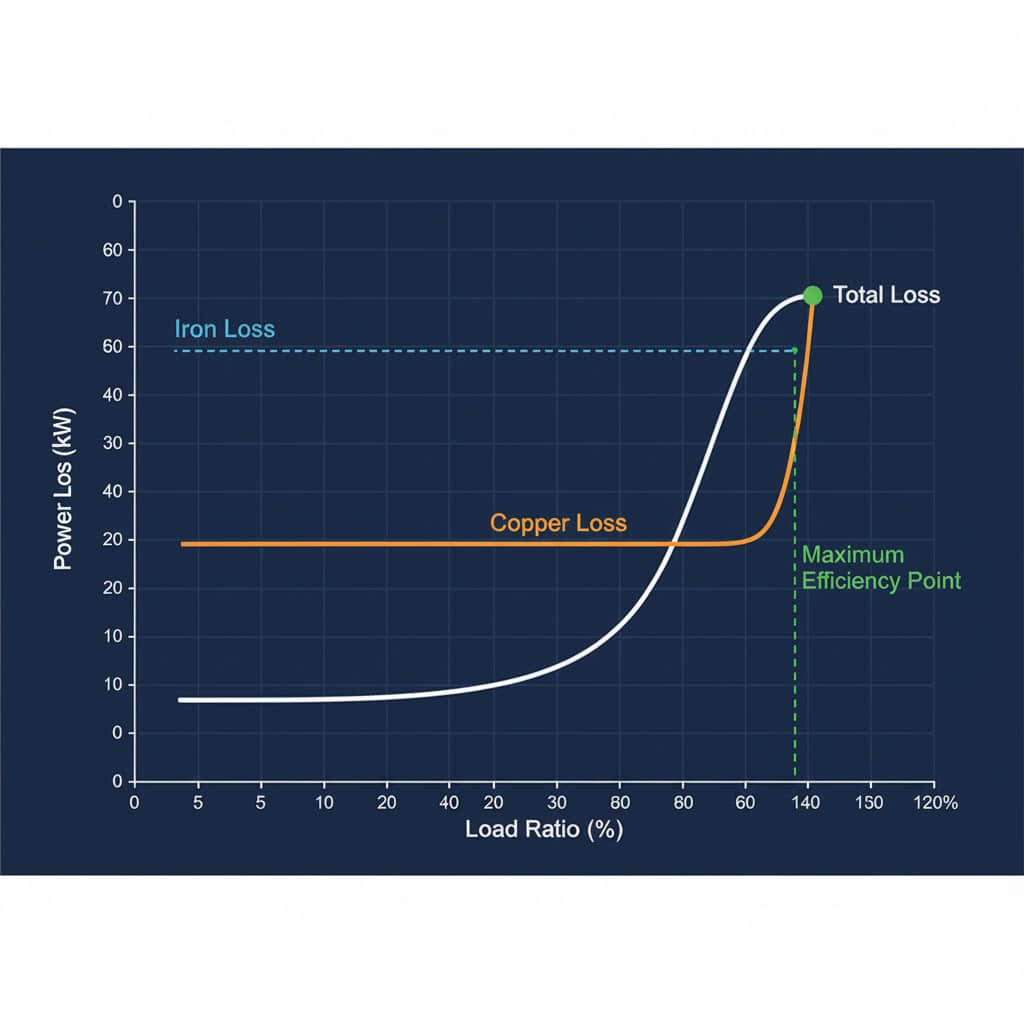
∙ The Maximum Efficiency Sweet Spot: The highest possible efficiency for a transformer typically occurs when the copper loss is exactly equal to the iron loss (). In practical engineering design, distribution transformers are often optimized to hit this peak efficiency at a load factor between 50% and 70% to accommodate their characteristic light-load operation for much of the day. Conversely, the largest power transformers are engineered to achieve maximum efficiency at much higher loading rates.
VI. Key Differentiating Factors: Step-Up vs. Step-Down
To simplify the core engineering distinctions, the table below summarizes the fundamental differences between step-up and step-down transformers across design parameters and field applications.
VII. Real-World Applications and Differentiated Perspectives
A transformer is far more than a simple "voltage pump" in the grid; its utility extends deep into specialized electrical and electronic engineering disciplines.
1. The AC Power Grid's Relay Race
The modern power system operates as one massive, coordinated "Step-Up/Step-Down Cycle."
∙ The Boost: At the generating station, colossal step-up transformers raise the voltage to hundreds of kilovolts.
∙ The Haul: Power is transmitted via UHV lines, where the extremely low current minimizes line loss.
∙ The Descent: At subsequent substations, step-down transformers progressively reduce the voltage level down to the regional distribution class.
∙ The Finish Line: The local distribution transformer executes the final voltage reduction, bringing the power safely to household levels, completing the energy relay.
2. The Renewable Energy Interconnection Mandate
The structure of the modern power system is changing, with more intermittent renewable sources like solar and wind joining the grid. These generators often output power at relatively low voltages, such as 690V or 800V from large-scale PV inverters.
To integrate this generated power into the high-voltage transmission network, massive step-up transformers are required to boost the voltage to the necessary 35kV, 110kV, or higher synchronization standards. These modern transformers are specialized, demanding advanced capabilities like enhanced Low Voltage Ride-Through () performance to cope with inherent grid voltage fluctuations.
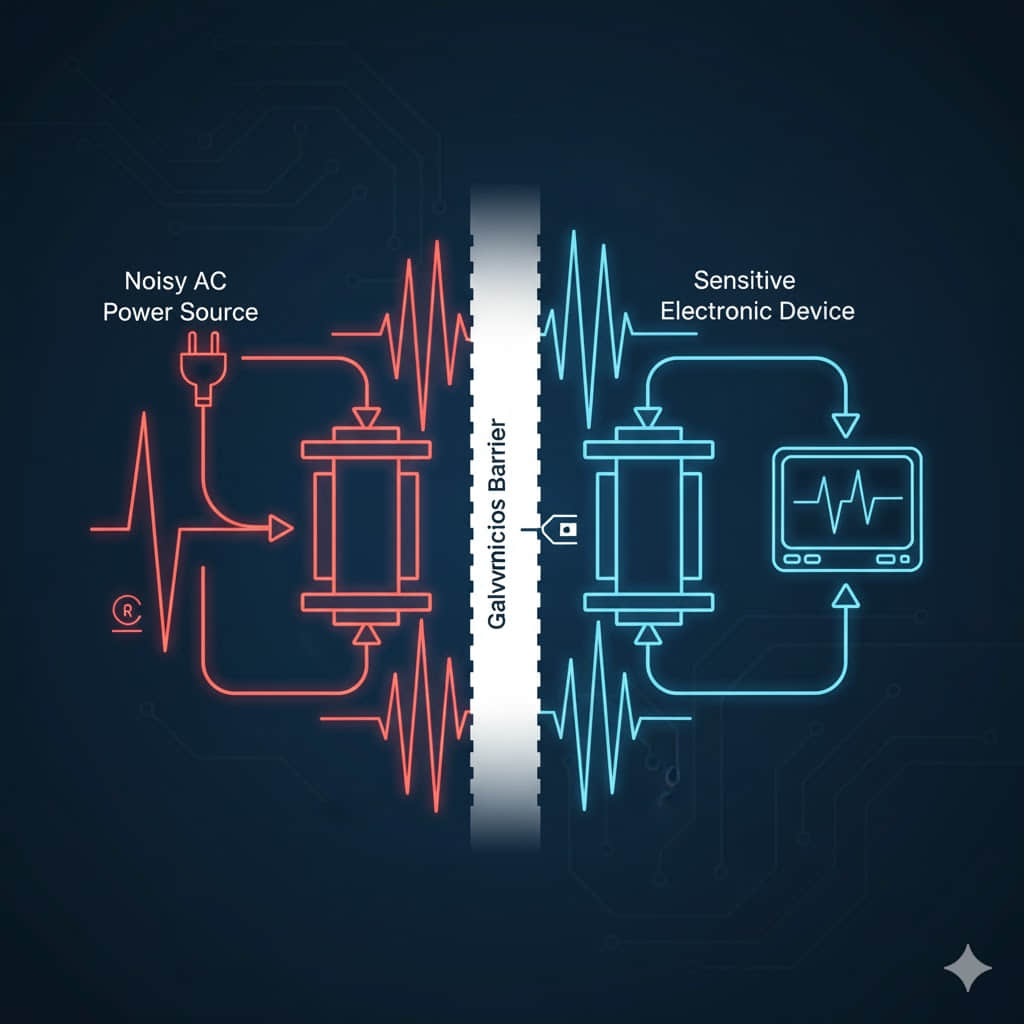
3. Electrical Isolation and Safety: The Unsung Hero (High-Level Application)
This is arguably the most critical, yet often overlooked, safety function of a transformer. Energy transfer is accomplished through magnetic coupling, meaning there is no direct ohmic connection between the primary and secondary coils. This inherent characteristic makes the transformer the perfect candidate for achieving Galvanic Isolation.
∙ Personnel Safety: In sensitive environments like medical facilities (e.g., operating room power supplies), wet-area devices, or maintenance test equipment, an Isolation Transformer—often featuring a turns ratio—is deployed. It doesn't change the voltage magnitude but completely separates the secondary circuit from the primary-side grounding system, preventing dangerous shock hazards caused by ground faults or accidental shorts.
∙ Noise Suppression: A transformer's weak capacitive coupling is an asset in electrical safety. It allows the transformer to be remarkably effective at suppressing high-frequency common-mode noise and transient surges that travel along the primary power line. This protective function safeguards sensitive downstream electronic equipment and ensures signal integrity.
4. Impedance Matching in Electronic Engineering
In the specialized fields of telecommunications and audio electronics, transformers serve a distinct purpose: Impedance Matching.
∙ The Principle: A transformer possesses the unique ability to transform a load's impedance (ZL) into an equivalent input impedance (Zin) as seen by the primary side. This transformation is governed by the square of the turns ratio.
∙ The Application: A prime example is the output stage of audio amplifiers. Here, a transformer is used to match the high output impedance of the power amplifier tube or transistor to the typically low input impedance of a loudspeaker (usually 4Ω or 8Ω). This careful matching ensures maximum power transfer to the speaker, which is key to optimizing the acoustic system's efficiency and overall sound quality.
VIII. Conclusion: The Foundation of Electrification
1. Core Summary: The AC Power Duo
The step-up and step-down transformers, defined by their unique turn ratios, form the bedrock of modern electrical engineering. The former is engineered to secure highly efficient power transmission, while the latter is tasked with guaranteeing safe and reliable power distribution. Through the elegant manipulation of electromagnetic induction, these devices masterfully transfer and distribute power without altering frequency, seamlessly connecting the massive energy output of a power plant to the minute power demands of an individual device.
2. Future Outlook: Smarter, Leaner, Faster
The transformer technology landscape is constantly evolving, driven by the global energy transition toward higher efficiency, greater compactness, and enhanced intelligence.
∙ Next-Generation Efficiency: The industry is pushing limits using advanced materials like amorphous alloys and even experimental superconducting windings, aiming to push efficiencies past 99.9% by further slashing both copper and iron losses.
∙ High-Frequency Miniaturization: In the realm of power electronics, the increasing adoption of high-frequency transformers allows power modules—such as those found in electric vehicle chargers—to achieve drastic reductions in both size and weight.
∙ Smart Grid Integration: Transformers are increasingly being fitted with integrated sensors and communication modules, transforming them into "Smart Transformers." This evolution facilitates real-time remote monitoring, predictive fault diagnosis, and dynamic load management, all essential capabilities for accommodating the fluctuating demands of distributed energy resources and complex modern grids.
— Frequently Asked Questions (FAQ) —
∙ Q1: What is the difference between a transformer and a power adapter?
A: A transformer is a core electrical component, exclusively responsible for either raising or lowering voltage (AC to AC). A power adapter, or power supply, is a complete electronic system; it typically contains a step-down transformer (or a similar conversion circuit), a rectifier (to change AC to DC), and a regulator circuit, designed to provide a stable, safe Direct Current (DC) output for electronic devices. Essentially, the transformer is just one critical part inside many power adapters.
∙ Q2: Why can't a transformer be used with Direct Current ()?
A: The fundamental working principle of a transformer relies on electromagnetic induction. According to Faraday's Law, the induction of an electromotive force in the secondary coil absolutely requires a changing magnetic flux. A Direct Current (DC) flowing through the primary coil generates a constant, unchanging magnetic field, which consequently fails to induce any voltage in the secondary coil. Furthermore, applying DC to the primary winding would lead to an immediate, massive DC draw due to the winding's inherently low resistance, which would cause severe overheating and likely burn out the coils.
∙ Q3: Can a transformer create energy?
A: Absolutely not. A transformer is fundamentally an energy conversion and transfer device, not a source of energy. In a hypothetical ideal scenario, the input power equals the output power. In reality, due to internal losses, the output power is invariably slightly less than the input power (), although modern transformers boast incredibly high efficiencies, typically ranging from 95% to over 99.9%. It rigorously adheres to the law of energy conservation.
∙ Q4: What is an "Autotransformer," and how does it differ from a standard transformer?
A: An Autotransformer operates with only a single winding, where a portion of that coil is shared by both the primary and secondary circuits. Its main advantages are smaller size, higher efficiency, and lower cost, particularly when the desired step-up or step-down ratio is small (e.g., converting 220V to 200V). However, a critical drawback is that it does not provide galvanic electrical isolation (since the primary and secondary are conductively connected), making it unsuitable for applications where safety isolation—such as in medical or sensitive testing equipment—is mandatory.
∙ Q5: What causes the characteristic "humming" sound that a transformer makes?
A: The familiar "hum" or buzz is caused primarily by two physical phenomena: Magnetostriction and Electromagnetic Forces.
∙ Magnetostriction: The magnetic core material undergoes minute physical dimensional changes (expansion and contraction) when subjected to an alternating magnetic field. This mechanical vibration is transmitted to the surrounding air, typically at a frequency of 100Hz or 120Hz (double the supply frequency).
∙ Electromagnetic Forces: The alternating current also generates electromagnetic forces between the core and the windings, and within the windings themselves, causing slight structural vibrations. Noise reduction is typically achieved by tightly clamping the core, impregnating the windings with epoxy (in dry-type transformers), or optimizing the core design to dampen mechanical movement.