The Critical Role of HV Arresters
Selecting the correct surge arrester for high-voltage applications demands a precise technical balance, focusing chiefly on the Maximum Continuous Operating Voltage (MCOV), the residual voltage (or protective level), and the arrester’s energy absorption capability.
You must ensure the voltage is high enough to prevent premature activation while the residual voltage is low enough to effectively protect your critical equipment's insulation integrity.
The high-voltage power grid, acting as the primary conduit for energy transmission, is perpetually under siege from transient overvoltages that threaten its stability and longevity.
These voltage spikes originate from two main sources: spectacular, high-current lightning overvoltages and longer-duration, high-energy switching overvoltages generated by system operations.
Both types of overvoltages pose a catastrophic risk to core components like transformers, reactors, and GIS (Gas Insulated Switchgear), potentially leading to insulation breakdown and massive system failures.
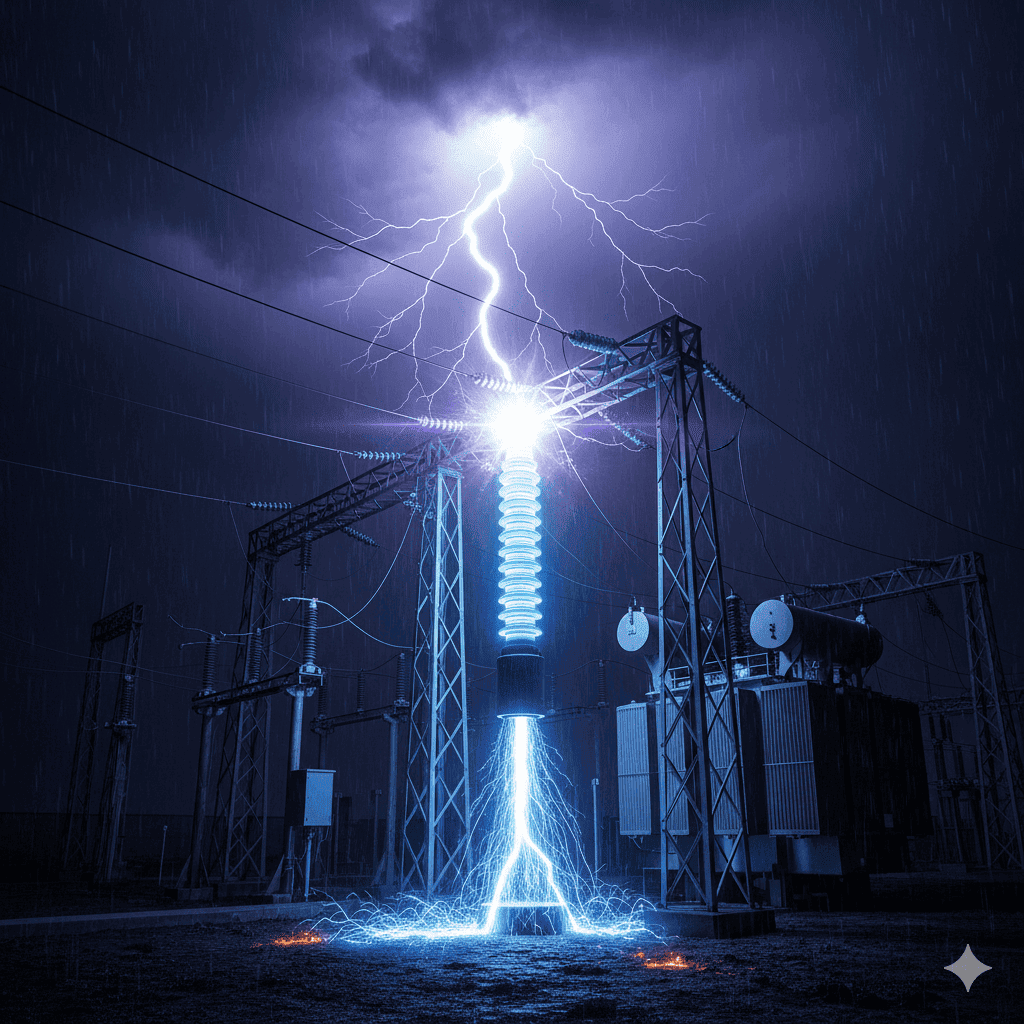
The Metal-Oxide Arrester (MOA) functions as an ultrafast voltage limiter within the system, utilizing its highly nonlinear voltage-current (V-I) characteristics to clamp transient voltages below the protected equipment's Basic Insulation Level (BIL).
This makes the an indispensable and final line of defense in maintaining the health and reliability of any infrastructure.
This guide moves beyond simple parameter lists to adopt the perspective of an experienced electrical engineer, focusing on crucial design and long-term maintenance considerations.
We will delve deeply into the quantitative selection criteria, introduce the golden rules of insulation coordination, analyze the trade-offs between various arrester housing materials, and finally explore advanced condition monitoring techniques essential for a differentiated and robust selection strategy.
Understanding the Overvoltage Threat
Transient overvoltages are fundamentally divided by their source, each presenting a distinct challenge to equipment insulation and requiring different arrester characteristics for effective mitigation.
Lightning strikes, for instance, introduce current surges with extremely steep wavefronts and microsecond-scale durations, demanding arresters with rapid response times and high impulse current ratings.
Conversely, switching operations—such as opening circuit breakers on long transmission lines or de-energizing large shunt reactors—produce oscillating transients that last much longer, often tens to hundreds of microseconds, necessitating arresters with superior energy handling capacity.
Ignoring either threat can lead to premature failure: an arrester rated only for lightning might be destroyed by a switching surge, while one focused solely on energy handling might be too slow to protect against a fast-rising lightning impulse.
The selection process, therefore, requires a comprehensive analysis of the system's operational profile and environmental exposure to accurately characterize the expected overvoltage events.
This integrated view ensures the chosen arrester provides balanced, holistic protection across all foreseeable transient conditions.
II. Core Parameter Selection: Defining the Arrester's Boundaries
Correct arrester selection is rooted in accurately matching the device’s fundamental technical parameters to the specific demands of the HV system.
The performance, longevity, and safety of the system are entirely contingent upon these four critical metrics aligning with the operational requirements.
Maximum Continuous Operating Voltage (MCOV) Determination
The is defined as the maximum root mean square (RMS) power frequency voltage that the arrester can continuously sustain over its expected operational lifespan.
This is unequivocally the most important and foundational parameter in the selection process, as it directly governs the arrester’s operational safety.
The MCOV Principle
Under normal system voltages, the zinc oxide valve blocks must maintain a high-impedance state, allowing only a minute, mostly capacitive leakage current to pass through.
The rating dictates the arrester's tolerance for this steady-state condition without degrading the internal components.
When selecting theMCOV, established engineering practice mandates that this value must exceed the maximum power frequency phase-to-ground voltage that the protected system is expected to sustain.
Typically, a safety margin of 5% to 10% above the highest system phase-to-ground voltage is required to account for normal system voltage fluctuations and temporary overvoltages.
Without this critical safety margin, the arrester could be forced into a prematurely conductive state during routine voltage excursions, leading to excessive power dissipation within the valve blocks and a potentially catastrophic condition known as Thermal Runaway.
【Practical Demonstration: HV Arrester Rated Voltage Calculation】
To bridge the theoretical knowledge of MCOV selection with practical engineering application, the following video demonstrates the quantitative steps for calculating the required arrester rated voltage (also known as LA Rating).
The calculation uses common system voltages, such as and400kV, incorporating the necessary safety margins.
The Mechanism of Thermal Runaway
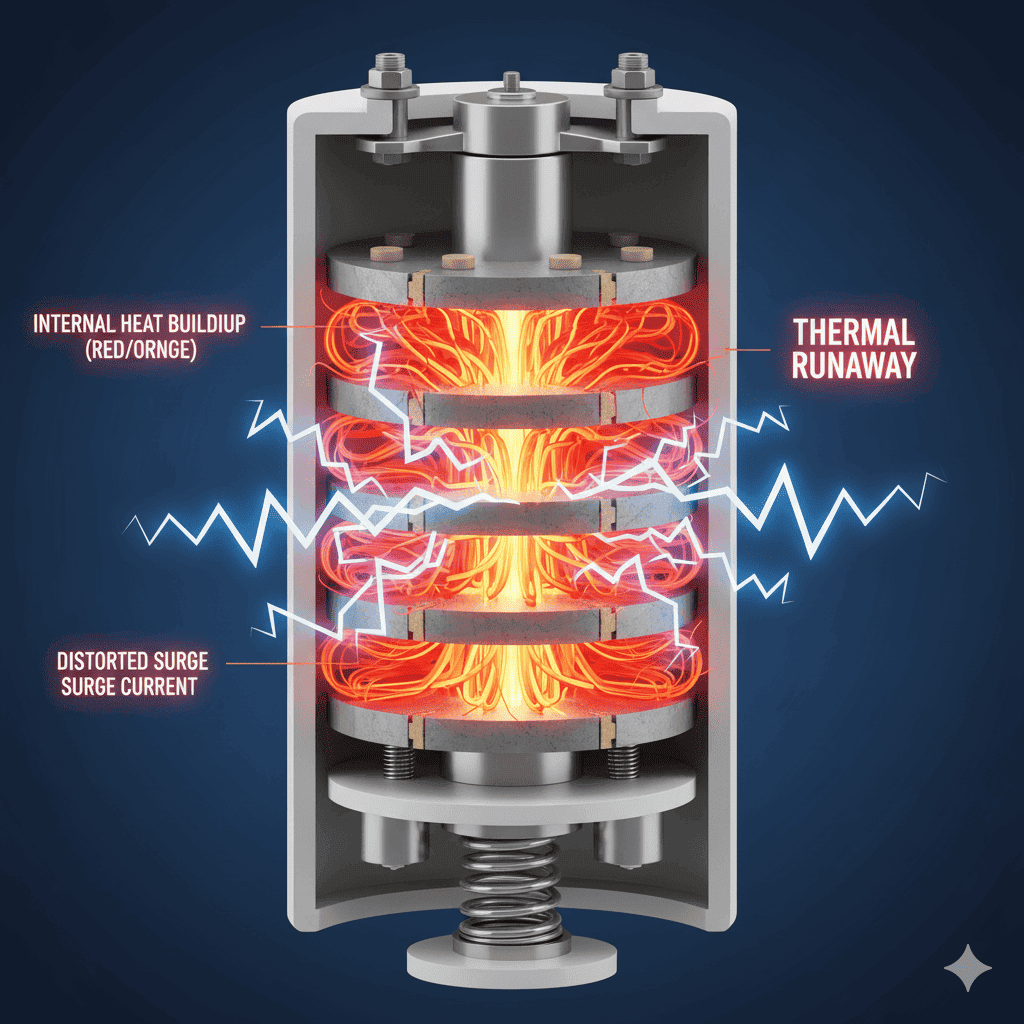
Thermal runaway represents the primary failure mode for inadequately specified or aged components and occurs when the heat generated internally by the resistive leakage current exceeds the heat dissipated to the surrounding environment.
As the temperature of the blocks increases due to elevated voltage or internal degradation, the resistive component of the leakage current rises exponentially, creating a positive feedback loop that accelerates the heating process.
This self-destructive cycle culminates in the melting, puncture, or explosive failure of the valve blocks, rendering the arrester inoperable and potentially damaging the surrounding equipment.
A conservatively chosen arrester is the most effective preventative measure against this failure mode, ensuring the arrester operates well within its safe temperature limits even when subjected to the highest anticipated system voltages.
However, system operators must also remain vigilant for factors like pollution and internal moisture ingress, which can drastically lower the arrester’s thermal threshold and lead to early failure even at a correct MCOV rating.
The is ultimately a steady-state thermal limit, and its selection is a direct trade-off between protection effectiveness and long-term thermal stability.
Residual Voltage (Protective Level) and Insulation Margin
The Residual Voltage, also frequently referred to as the limiting voltage or the clamping voltage, is the instantaneous voltage that develops across the terminals of the arrester while a surge current of a specified waveshape and magnitude (e.g., the standard impulse current) flows through it.
This parameter serves as the definitive measure of the arrester's protective capability.
Residual Voltage and Equipment Stress
The residual voltage directly quantifies the actual voltage stress imposed upon the protected equipment during a transient event.
A lower residual voltage is invariably better, as it minimizes the stress applied across the insulation of the protected asset, thereby maximizing its lifespan and reliability.
It is, therefore, considered the most crucial indicator for assessing the immediate protective performance of the surge arrester.
The fundamental selection rule dictates that the arrester’s residual voltage must always be significantly lower than the protected equipment’s Basic Insulation Level (BIL).
Furthermore, the selection must strictly comply with the requirements for Insulation Coordination, a topic we will explore more deeply in the following section.
This quantitative comparison between the arrester's clamping ability and the equipment's tolerance level is what validates the entire protection scheme.
Energy Absorption Capability (Joule Rating) Assessment
Beyond its primary function as a voltage limiter, the surge arrester must also be a highly efficient energy absorber, capable of safely dissipating substantial amounts of transient energy.
Energy Sources and Arrester Stress
While lightning strikes generate enormous current peaks, they are typically very short-lived; consequently, the overall energy content (E=∫P(t)dt) is often not the most taxing stressor for the MOA blocks.
The majority of the energy challenge in high-voltage applications actually stems from switching overvoltages.
For example, the interruption or closure of long transmission lines or large inductive loads, such as massive shunt reactors, can produce transient surges with a longer duration—sometimes lasting for milliseconds—that carry a far greater total energy content than a lightning strike.
The arrester's energy absorption rating (often specified in Joules per unit volume, or per kV of MCOV) must be rigorously evaluated through detailed system transient simulations.
This simulation ensures the selected device can safely and repetitively dissipate the maximum transient energy anticipated from system operations without suffering physical damage or degradation.
For mission-critical installations like power plant switchyards, substation entrance points, and connections to long transmission corridors, engineers must specifically choose Heavy Duty arresters that are validated for a higher energy classification.
Nominal Discharge Current Selection
The Nominal Discharge Current defines the peak current value used during standardized impulse testing to verify the arrester’s ability to withstand surge events without immediate failure.
The proper selection of this current rating must be meticulously guided by the actual lightning activity levels prevalent at the installation site.
Arrester Classification
Surge arresters are classified based on their nominal discharge current ratings, commonly falling into categories such as10kA, or 20kA.
In regions with extremely high lightning flash density or in areas where overhead line protection (like overhead ground wires) is known to be sub-optimal, the standard arrester may not suffice.
In these high-exposure environments, engineers should select a higher nominal discharge current rating, such as20kA, to guarantee the arrester's long-term reliability and integrity across multiple high-magnitude lightning strikes.
Engineer's Note: Remember, the MCOV selection is a thermal decision that ensures the arrester's safety and longevity (preventing Thermal Runaway), while the Residual Voltage is an electrical decision that dictates the arrester's protective efficacy (limiting voltage stress). Both parameters are equally crucial and must be optimized simultaneously for a balanced design.
III. Insulation Coordination: The Golden Rule of HV Protection
Arrester selection is not a standalone process of parameter matching; it is an intrinsic element of Insulation Coordination, a system-level design philosophy.
This disciplined approach elevates the task from merely selecting a product to developing a robust system protection scheme.
Protective Margin Calculation
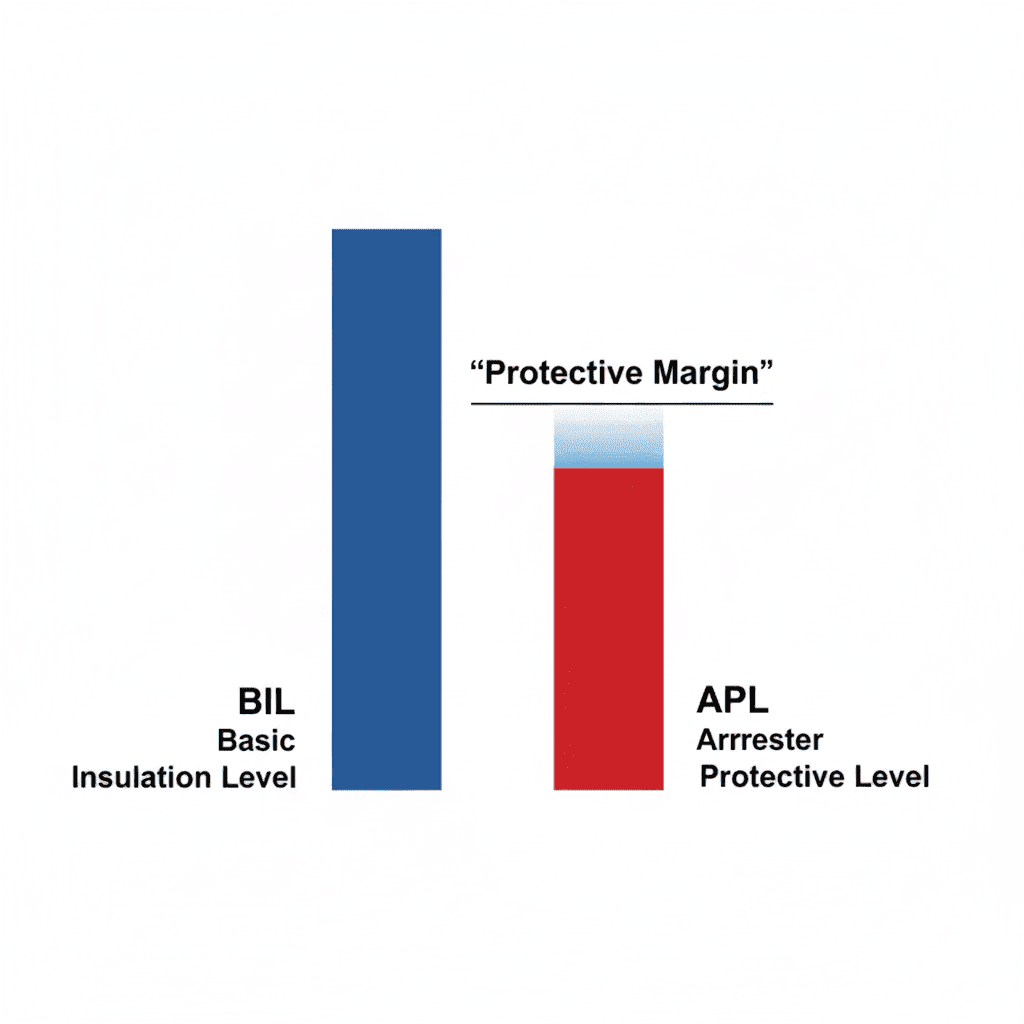
The fundamental objective of insulation coordination is to guarantee that a safe and sufficient buffer, known as the Protective Margin, is maintained between the equipment’s insulation tolerance and the protection level provided by the arrester.
Defining the Levels
The Arrester Protective Level (APL) is practically defined by the maximum residual voltage of the arrester under the relevant impulse conditions (either lightning or switching).
Conversely, the Basic Insulation Level (BIL) is the voltage tolerance certified by the equipment manufacturer, representing the highest standard impulse voltage that the equipment can withstand without suffering an electrical breakdown.
The Margin Requirement
The protection scheme must rigorously satisfy the following fundamental engineering requirement:
The Margin Factor (Insulation Coordination Factor) is the crucial variable determined by the design engineer.
In contemporary engineering practice, this factor is typically set between 1.15 and 1.25 (a 15% to 25% margin).
If the margin is too thin, the equipment faces a high probability of failure should the arrester itself fail or operate slightly late.
Conversely, setting an excessively large margin can lead to over-specifying the insulation, which significantly drives up equipment cost and size without providing meaningful added protection.
Impact of System Grounding on the Margin Factor
The power system's grounding configuration is a determining factor in the degree to which phase-to-ground voltage rises during a fault, which in turn profoundly influences the choice of MCOV and the subsequent design of the protective margin.
Effectively Grounded Systems
In effectively grounded systems (where the neutral point is solidly or effectively grounded), the fault overvoltage factor is inherently lower, and the rise in phase-to-ground voltage during a single-phase-to-ground fault is strictly limited.
This favorable condition allows engineers to select a comparatively lower MCOV rating for the arrester and simplifies the overall requirements for insulation coordination.
The transient stresses are typically well-controlled, making the protection scheme more straightforward.
Non-Effectively Grounded Systems
In non-effectively grounded systems (e.g., those with ungrounded neutral points or grounded through an arc-suppression coil), a single-phase-to-ground fault can cause the voltage on the healthy phases to surge up towards the system's line-to-line voltage.
This necessitates the selection of a much higher for the arrester to prevent immediate thermal failure during a fault.
The higher fault overvoltage factor in these systems also demands a greater insulation margin to manage the more complex and severe transient overvoltages effectively.
Design Tip: When designing for Extra High Voltage (EHV) systems, such as 500kV and above, the insulation coordination margin must be applied with extreme prudence. A robust margin (around 20%) ensures the high-value equipment does not experience insulation failure even under the most extreme anticipated conditions.
IV. Arrester Technology and Housing Materials: Engineering Trade-Offs
Technical Superiority of Metal-Oxide Arresters (MOA)
Modern high-voltage systems have almost universally adopted gapless designs due to their overwhelming technical advantages over older silicon carbide technology.
The core strength of the lies in its phenomenal material science.
The zinc oxide valve blocks exhibit an exceptional degree of nonlinearity in their characteristic curve.
Under normal power frequency voltage, the blocks present an extremely high impedance, effectively acting as an open circuit.
Crucially, when an overvoltage transient occurs, the resistance rapidly drops to a near-zero level, instantaneously clamping the voltage.
Furthermore, the material rapidly recovers its high-impedance state immediately after the overvoltage transient has safely passed, eliminating the issue of power-frequency follow current that plagued older gap-type arresters.
The gapless design is perhaps the most significant practical advantage.
The absence of spark gaps eliminates the inherent time delay and variability associated with gap flashover, providing near-instantaneous operation.
This ensures that even the steepest-fronted lightning impulses are met with immediate voltage limiting, maximizing the protective response.
Housing Material Choice: Polymer vs. Porcelain
The choice of the arrester's housing material is a pragmatic engineering decision that extends far beyond simple dielectric performance, directly impacting the entire Life Cycle Cost (LCC), safety profile, and maintenance requirements of the asset.
Engineers must carefully weigh these real-world factors.
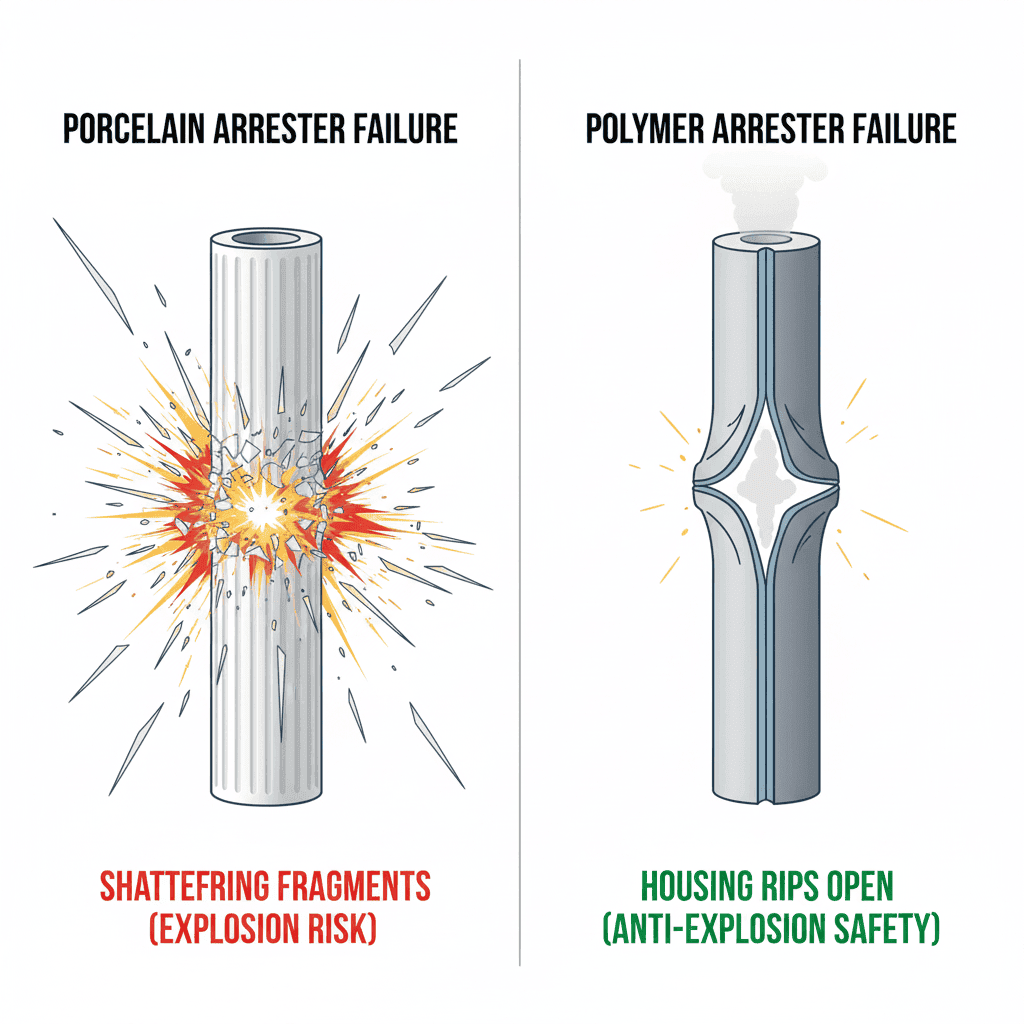
| Feature Comparison | Polymer Housing (Silicone Rubber) | Porcelain Housing (Ceramic) | Engineering Selection Focus |
| Weight & Installation | Lightweight, simplifying transport and installation procedures, requiring less robust support structures. | Heavy, necessitating strong foundations and complex lifting procedures, which adds to construction time. | LCC and installation difficulty |
| Explosion Safety | Excellent. Internal pressure buildup causes the housing to tear safely, rapidly releasing pressure without explosive fragmentation. | Poor. Internal pressure can build until catastrophic rupture, resulting in high-velocity shard projection, posing a severe risk. | Personnel and equipment safety |
| Contamination Performance | Superior. Features inherent hydrophobicity (water-repellency), preventing water film formation and tracking across the surface. | Inferior. Susceptible to water film formation on polluted surfaces, requiring costly regular cleaning or an extended creepage distance. | Maintenance cost and environmental suitability |
| Mechanical Strength | Lower. Susceptible to damage from high mechanical loads, such as high wind or direct impact. | Extremely High. Superior resistance to bending and tensile stresses, ideal for areas prone to seismic activity. | Seismic areas or high wind loading zones |
| Aging & Lifetime | Organic material, subject to degradation mechanisms like chalking, erosion, or localized partial discharge over decades. | Inorganic material, offering superior long-term stability and a much longer intrinsic service life. | Long-term asset reliability |
Engineer's Mandate: In highly populated areas or on transmission towers where structural loading is a concern, Polymer Housing is the definitive choice due to its non-shattering, anti-explosion safety characteristic.
However, for extremely high mechanical load environments or where long-term material stability is paramount, the robustness of Porcelain may still be preferred, provided adequate explosion containment measures are in place.
Note: The explosion safety offered by the Polymer Housing is its largest distinguishing advantage, an increasingly critical factor for modern HV substation design, especially given the proximity to other high-value assets.
V. Comprehensive System and Environmental Context
System Characteristics Analysis
The first analytical step is to characterize the specific nature of the overvoltage threats the system faces.
Engineers must definitively establish whether the primary risk profile is dominated by high-current lightning events (typical on long overhead transmission lines) or by longer-duration, high-energy switching events (common near large capacitor banks, underground cable transitions, or reactor installations).
This determination directly dictates whether to emphasize the arrester's nominal discharge current or its energy absorption capability during the selection process.
Simultaneously, the system's nominal voltage and power frequency must be confirmed to ensure basic compatibility.
Installation Site Environmental Factors
Environmental conditions severely impact the arrester's external performance and long-term reliability, demanding site-specific design considerations.
Contamination Level (Creepage Distance)
The arrester must be selected based on the pollution severity classification of the installation site.
For highly polluted areas—such as coastal regions (salt fog), industrial zones (dust and chemicals), or mining areas—a housing design with a sufficiently high Creepage Distance must be chosen.
The creepage distance is the shortest path along the external surface of the insulator between the high-voltage terminal and the ground, and it is the single most important parameter for resisting contamination flashover.
Altitude
High-altitude installations introduce unique thermal and dielectric challenges.
As atmospheric density decreases with altitude, the external insulation strength is reduced, necessitating an altitude correction factor for the external components.
Furthermore, the reduced air density can also impair the heat dissipation capabilities of the arrester housing, requiring engineers to apply a thermal correction factor to the MOAarrester's continuous operating rating to prevent overheating and premature thermal aging.
VI. The Six-Step HV Arrester Selection Procedure
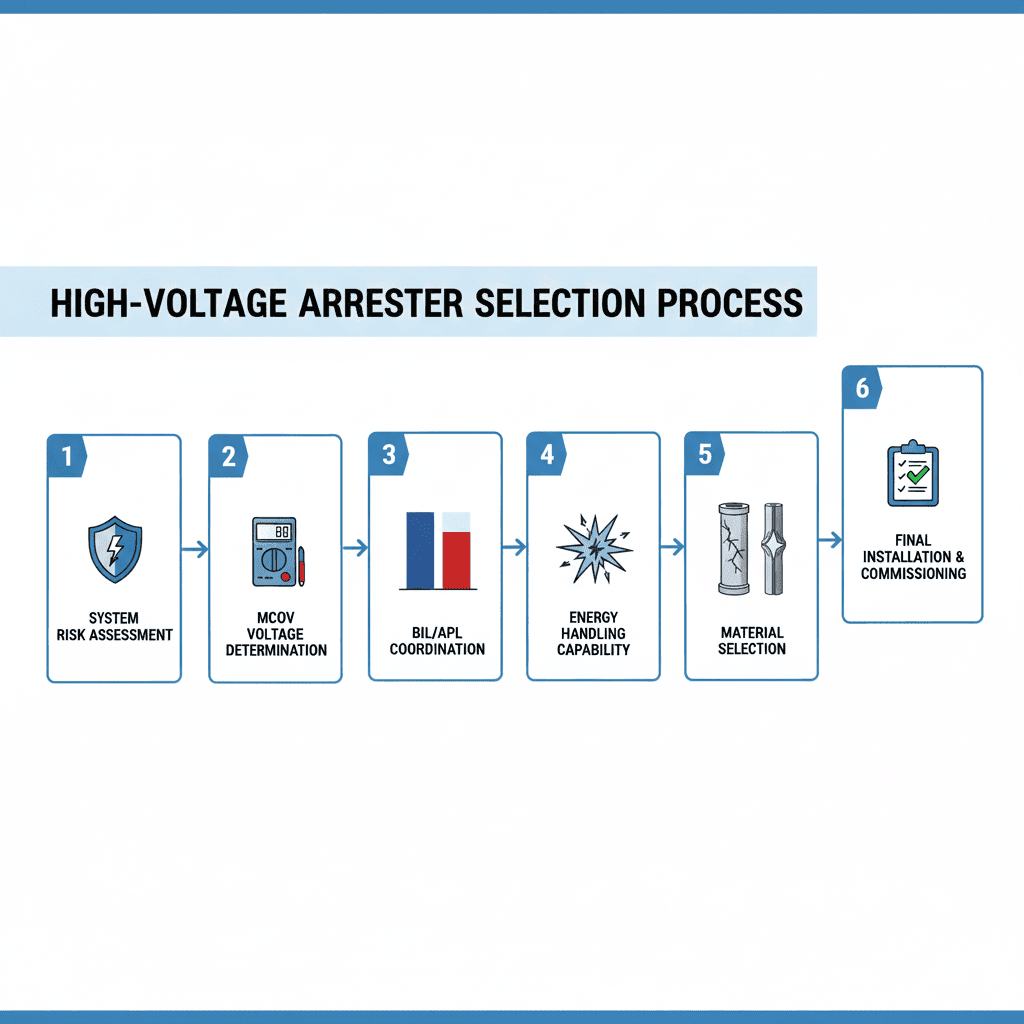
High-Voltage Arrester Selection Six-Step Summary
The comprehensive selection process can be distilled into the following systematic, step-by-step procedure, ensuring all technical and operational requirements are addressed in a logical sequence.
Step 1: Risk Assessment and System Definition: Identify all critical assets requiring protection and firmly establish the system's nominal voltage, grounding configuration, and the expected lightning activity level (flash density).
Step 2: DetermineMCOV: Calculate the maximum sustained phase-to-ground voltage and apply the necessary thermal safety margin (≥1.05) to derive the Minimum Required MCOV.
Step 3: Establish Insulation Standard (BIL): Reference the Basic Insulation Level (BIL) as specified by the manufacturer of the protected equipment (e.g., transformer).
Step 4: Optimize Residual Voltage (APL): Calculate the maximum permissible residual voltage by dividing the BIL by the Insulation Coordination Margin Factor, and then select an arrester model whose actual residual voltage is below this calculated limit.
Step 5: Evaluate Energy Absorption Capacity: Based on system transient analysis and simulation results, verify and confirm that the arrester’s energy rating is adequate to safely dissipate the anticipated maximum transient energy, with particular focus on switching surges.
Step 6: Final Type and Housing Selection: Decide on the optimal housing material (Polymer vs. Porcelain) and mechanical configuration based on site environmental conditions, mechanical constraints, safety requirements, and totalLCC.
Table: High-Voltage Arrester Key Parameter Checklist
| Key Parameter | Definition and Function | Selection Principle | Potential Risk (Incorrect Selection) |
| MCOV | The maximum continuous power frequency voltage limit that the arrester can withstand. | MCOV≥1.05× Maximum System Phase-to-Ground Voltage | Thermal Runaway (Internal arrester destruction/failure) |
| Residual Voltage | Voltage across the terminals during surge current flow. | Must be as low as possible; Must satisfy BIL/APL≥Margin Factor | Protection Failure (Insulation breakdown of the protected equipment) |
| Energy Absorption | Total transient energy the arrester can safely dissipate. | Must exceed the system’s predicted transient energy (especially for switching surges) | Arrester physical damage or catastrophic explosion, leading to complete protection loss |
| Housing Material | Provides external insulation and mechanical protection. | Must be determined by balancingLCC, environmental contamination level and the explosion safety needs. | Contamination flashover, mechanical damage, or explosive failure |
| Nominal Discharge Current | Measure of the arrester’s ability to withstand high impulse currents. | Should match the lightning activity classification of the installation site. | Accelerated valve block degradation and failure under repeated lightning strikes |
VII. Operational Monitoring and Failure Analysis: From Selection to Maintenance
The operates as a passive device, often installed in harsh environments, and its internal valve block degradation is an insidious, cumulative process.
The truly skilled engineer understands that the selection process is only the beginning; Operational Monitoring is the indispensable discipline that guarantees long-term system reliability.
Analysis of Typical Failure Modes
The degradation and eventual failure of an are typically the result of several interacting factors, often developing gradually over many years of service.
Thermal Runaway: As previously discussed, this catastrophic mode occurs when an ill-chosen or persistently elevated system voltage causes the heat generated internally to outpace the rate of heat dissipation. The resulting exponential increase in temperature leads to the physical destruction of the valve blocks.
Seal Failure and Moisture Ingress: A breach in the arrester housing’s external sealing system allows moisture to penetrate the interior. The damp environment drastically degrades the electrical characteristics of the valve blocks, causing an immediate and sharp increase in the resistive leakage current, which accelerates thermal aging.
Contamination Flashover: The accumulation of heavy external pollution on the housing surface can create a conductive path when moisture is present (e.g., fog or light rain). This results in an external surface flashover, which can cause both temporary system faults and physical damage to the arrester housing.
Online Monitoring Technology: The Key to Predictive Maintenance
Modern utility operations demand a transition from outdated "time-based scheduled maintenance" to sophisticated "predictive maintenance" strategies.
The true condition of the surge arrester can only be accurately ascertained by utilizing advanced online monitoring techniques.
Resistive Current (Ir) Monitoring
This is definitely the single most effective diagnostic technique available.
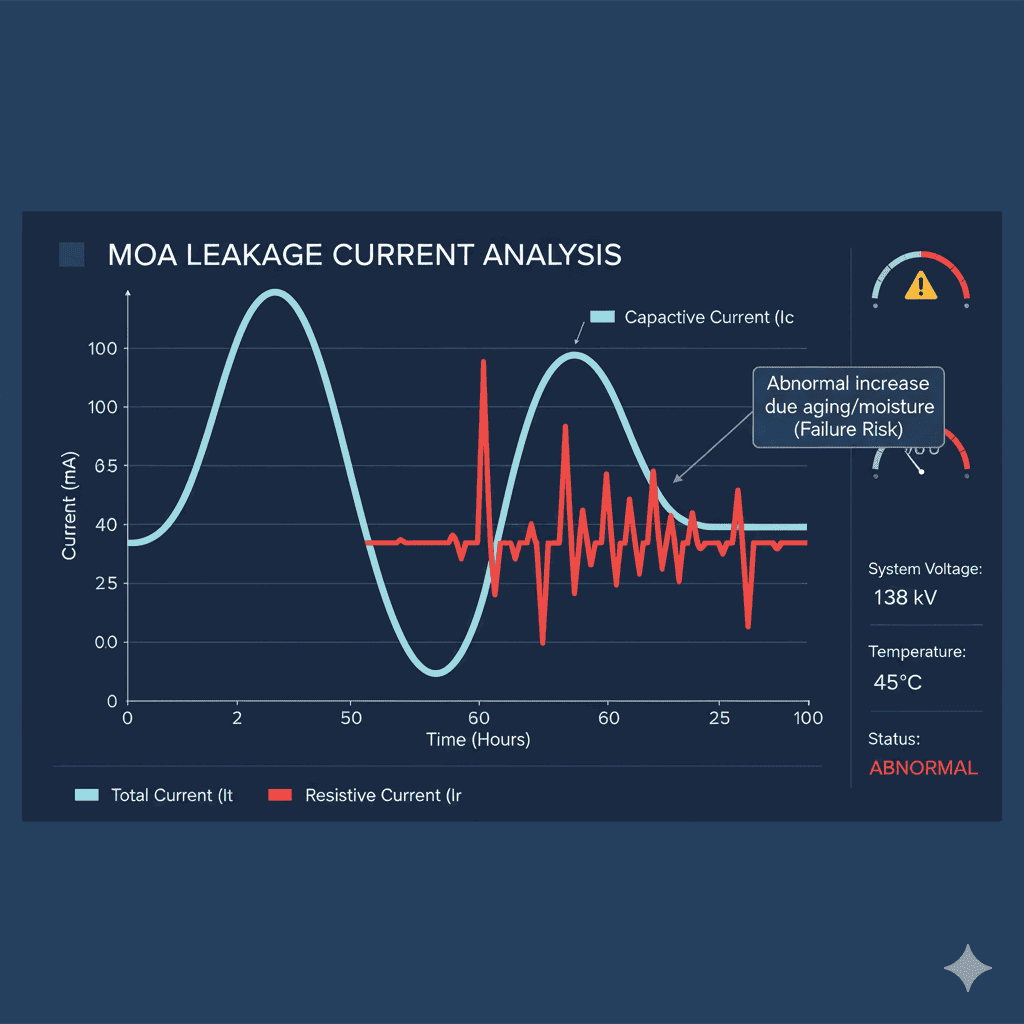
The total leakage current flowing through an is composed of two components: a predominant Capacitive Component (Ic) and a much smaller, non-linear Resistive Component (Ir).
The is primarily dependent on the and external temperature, while the is the critical diagnostic indicator.
When the valve blocks degrade due to aging or moisture, their non-linear properties weaken, causing the small Resistive Component (Ir) to increase significantly.
Engineers use sophisticated techniques, such as the third-harmonic analysis or multi-component compensation methods, to accurately separate and track the component.
A sustained and significant upward trend in the provides an early and precise warning of valve block degradation, allowing for replacement to be scheduled long before a catastrophic Thermal Runaway occurs.
Effective Interpretation of the Surge Counter
The traditional surge counter merely records the total number of times the arrester has operated by shunting a surge current.
The modern engineer must look beyond the total count and instead analyze the rate of counting.
An abnormally high counting rate over a short duration often signals an underlying system problem, such as persistent overvoltage events caused by abnormal switching operations, intermittent line faults, or the presence of ferroresonance.
VIII. Conclusion: Best Practice Guidelines
Summary: Arrester Selection is an Art of Balance
High-voltage surge arrester selection represents a dynamic engineering challenge that requires balancing three primary, often competing, requirements: ensuring the Residual Voltage is low (guaranteeing equipment safety), making sure the arrester is correctly matched (guaranteeing the arrester's own thermal integrity), and confirming the Energy Absorption Capability is sufficient (guaranteeing its survivability against system transients).
Furthermore, the strategic adoption of modern polymer housing technology offers enhanced safety and improvedLCC.
Enhancing Engineering Reliability and EEAT
To demonstrate the highest level of professional diligence and expertise, engineers must adhere to international standards and integrate advanced online monitoring solutions.
The utilization of Resistive Current analysis in particular provides the quantitative evidence needed for a truly predictive maintenance strategy, solidifying the protection scheme's long-term reliability against all threats.
A Call to Action: Digital Integration and Predictive Maintenance
We strongly advocate for the integration of surge arresters into the utility’s digital asset management ecosystem.
By leveraging real-time online monitoring data to guide maintenance schedules, utilities can move beyond reactive repairs and fully embrace predictive maintenance, maximizing both uptime and return on investment.
Appendix: High-Voltage Arrester Selection and Maintenance FAQ
Q1: Why must my substation arrester exceed the actual maximum phase-to-ground voltage by at least5%?
A: This mandatory 5% to 10% safety margin is specifically required to accommodate inevitable system voltage fluctuations and temporary power frequency overvoltages.
An inadequate margin is the leading operational cause of internal heat generation and subsequent Thermal Runaway, dramatically shortening the arrester's service life.
Q2: How can I detect if an arrester is internally moist or degraded without visible external signs?
A: Visual inspection is almost always insufficient to detect internal valve block degradation, as external housings often remain intact while the internal integrity is compromised.
The most scientifically sound method is through continuous online monitoring and analysis of the leakage current's Resistive Component.
A sustained increase in serves as a reliable early warning indicator for internal degradation due to moisture or aging.
Q3:Why is the energy absorption capacity especially demanding for arresters used on transmission lines?
A: Transmission line arresters must withstand not only lightning but, more importantly, the substantial energy generated by switching overvoltages.
Switching operations on long lines produces oscillating transients that have a far longer duration than lightning impulses; although the current peak may be lower, the overall energy content often exceeds that of a lightning surge.
Consequently, line-type arresters must be robustly rated as Heavy Duty products with superior energy absorption ratings.
Q4: Are polymer-housed arresters genuinely safer than porcelain-housed ones, and why?
A: Yes, polymer-housed arresters are generally considered safer, particularly within the congested confines of a substation.
The high internal pressure generated during a terminal failure causes the rigid porcelain housing to fail explosively, propelling dangerous ceramic fragments at high velocity.
The flexible polymer (silicone rubber) housing, however, is designed to tear along controlled seams, safely venting the internal pressure and exhibiting a crucial anti-explosion characteristic.
Q5: Is a uniform Insulation Coordination Margin Factor universally appropriate for all voltage classes?
A: No, it is not a universally applicable constant.
While it is a common industry benchmark, designs for Ultra High Voltage (UHVUHV) systems often utilize a slightly tighter margin due to the immense cost and physical size of insulation.
The selection of the Margin Factor must always be customized based on the system's grounding method, the severity of local overvoltages, the economic value of the protected equipment, and the utility's specific reliability requirements.